Sediment Transport Model
Accurately predicting sediment transport from bedload movement to suspended sediment concentration, erosion and deposition, is critical to designing hydraulic structures that perform reliably over their operational life. Yet it remains difficult to model with confidence, particularly where flow fields are highly three-dimensional, as in water intakes, stormwater separators, reservoir flushing and others. In these applications, sediment transport must be incorporated into the CFD simulation and cannot be simplified through depth-averaged approximations.
The Sediment Transport Model in FLOW-3D HYDRO simulates bedload and suspended sediment transport, erosion, and deposition for non-cohesive sediment. The model is fully coupled to the hydrodynamic solver, so the evolving bed geometry feeds back into the flow field at every time step. Up to 10 different sediment species can be defined simultaneously, each with its own grain size, density, critical shear stress, angle of repose, and transport parameters, allowing realistic representation of graded sediment mixtures.
Stormwater sediment basin simulated in FLOW-3D HYDRO, showing scalar flow patterns (left), suspended sediment concentration (center), sediment depth accumulation on the basin floor (upper right), and cross-sectional velocity (lower right). As sediment settles and deposits, the solid geometry updates within the model in real time.
How the Model Works
In FLOW-3D HYDRO, sediment exists in two states: a packed bed, represented by the FAVOR™ method as an erodible solid boundary, and as suspended sediment, represented as a scalar mass concentration transported with the fluid. The exchange between these two states is computed at every cell containing the bed interface.
Bedload Transport
Bedload transport is the movement of sediment grains rolling, sliding and saltating along the channel bed without entering full suspension. In FLOW-3D HYDRO, the volumetric bedload transport rate per unit width is computed using one of three well-established empirical equations: Meyer-Peter and Muller (1948) for gravel beds, Van Rijn (1984) for sand beds, and Nielsen (1992) for coastal wave environments. Bed shear stress is evaluated using the law of the wall, with bed roughness proportional to the local median grain diameter.
Entrainment and Suspension
Entrainment is the process by which turbulent eddies lift grains from the packed bed surface and carry them into suspension. The entrainment rate is based on the local Shields parameter relative to the critical value for that grain size. The critical Shields parameter can be computed automatically or specified directly and is adjusted for sloping bed surfaces using the angle of repose.
Particle-particle interactions at higher sediment concentrations are accounted for in the settling velocity calculation. The relative rates of entrainment and settling control the exchange of sediment mass between the packed bed and suspended states.
Modeling Capabilities
The Sediment Transport Model in FLOW-3D HYDRO supports:
- Unsteady 3D mobile bed modeling fully coupled to the hydrodynamic solver
- Bedload transport using Meyer-Peter and Muller, Van Rijn or Nielsen equations
- Suspended sediment transport, entrainment, and deposition for non-cohesive sediments
- Up to 10 simultaneous sediment species with independent grain size, density, critical shear stress, and angle of repose
- Slope-adjusted entrainment thresholds based on angle of repose
- Compatible with both 3D and shallow water mesh configurations
Validation
The Sediment Transport Model has been validated against a series of laboratory experiments covering a range of scour and deposition scenarios.
Pipeline Scour (Mao, 1986)
Laboratory experiments by Mao measured scour profiles beneath a submerged horizontal pipeline. Comparisons between measured and simulated maximum scour depth over time and cross-sectional scour profiles show good agreement.
Submerged Horizontal Jet Scour (Chatterjee et al., 1994)
Experiments by Chatterjee et al. measured scour hole depth and dune height over time for a submerged horizontal jet. Simulated and measured values match closely, with both reaching equilibrium in approximately one hour.
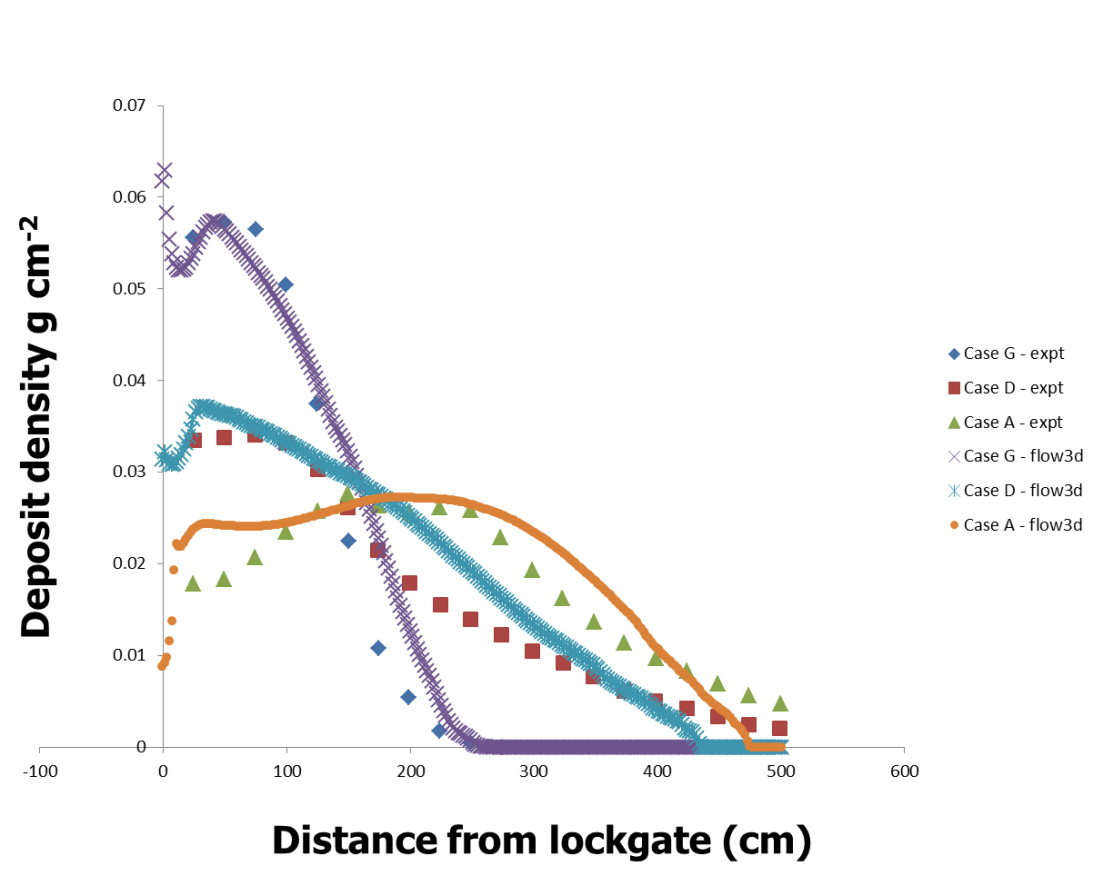
Particle-Laden Gravity Currents (Gladstone et al., 1998)
3D Wall Jet Scour (Faruque et al., 2006)
Faruque et al. studied local scour by three-dimensional submerged wall jets. Simulated morphological changes in the scour hole for three tailwater depth ratios compare well against experimental measurements.
Applications
The Sediment Transport Model in FLOW-3D HYDRO is best used for short duration local sedimentation applications.
- Bridge pier and abutment scour assessment for riverine environments to augment traditional HEC-18 scour calculations
- Local scour at spillways, plunge pools, and other energy dissipation with non-cohesive sediments. The sediment model should not be used for rock scour.
- Sedimentation and desiltation basin design and optimization
- Reservoir flushing and sediment management studies via a series of quasi steady state simulations to optimize operational sequencing
- Local sediment transport in mixed sand-gravel channels
Sediment scour at a spillway plunge pool, showing packed sediment net height change (upper left), velocity field with streamlines (upper right), and 3D scour hole geometry (bottom). Simulations like this support dam safety assessment by quantifying scour depth and lateral extent under design flood conditions.