Microfluidics Playlist
0:18
0:21
0:21
0:16
0:10
0:08
0:38
0:11
0:16
0:11
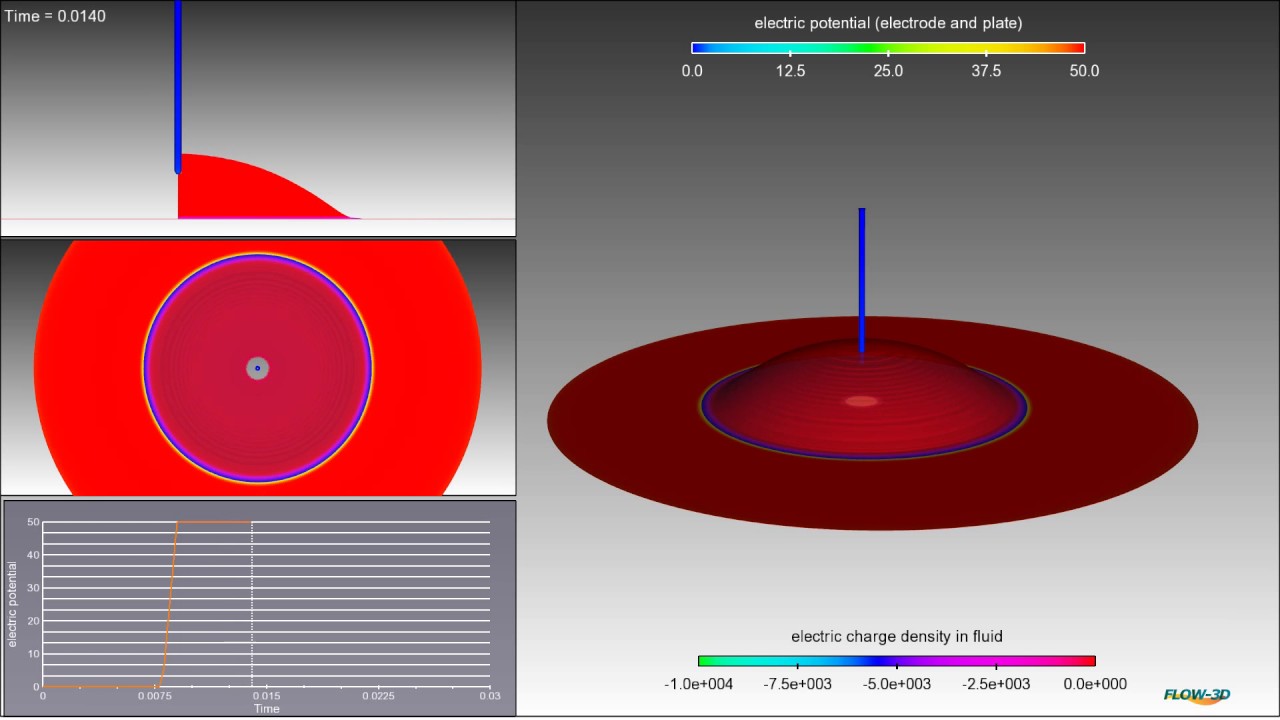
Electrowetting is a technique used to change the apparent contact angle of a dielectric fluid under the influence of electric potential. In this example, the fluid is originally hydrophobic and beads on the surface. However, when a 50V potential difference is applied, the fluid is forced to wet the surface becoming hydrophilic.
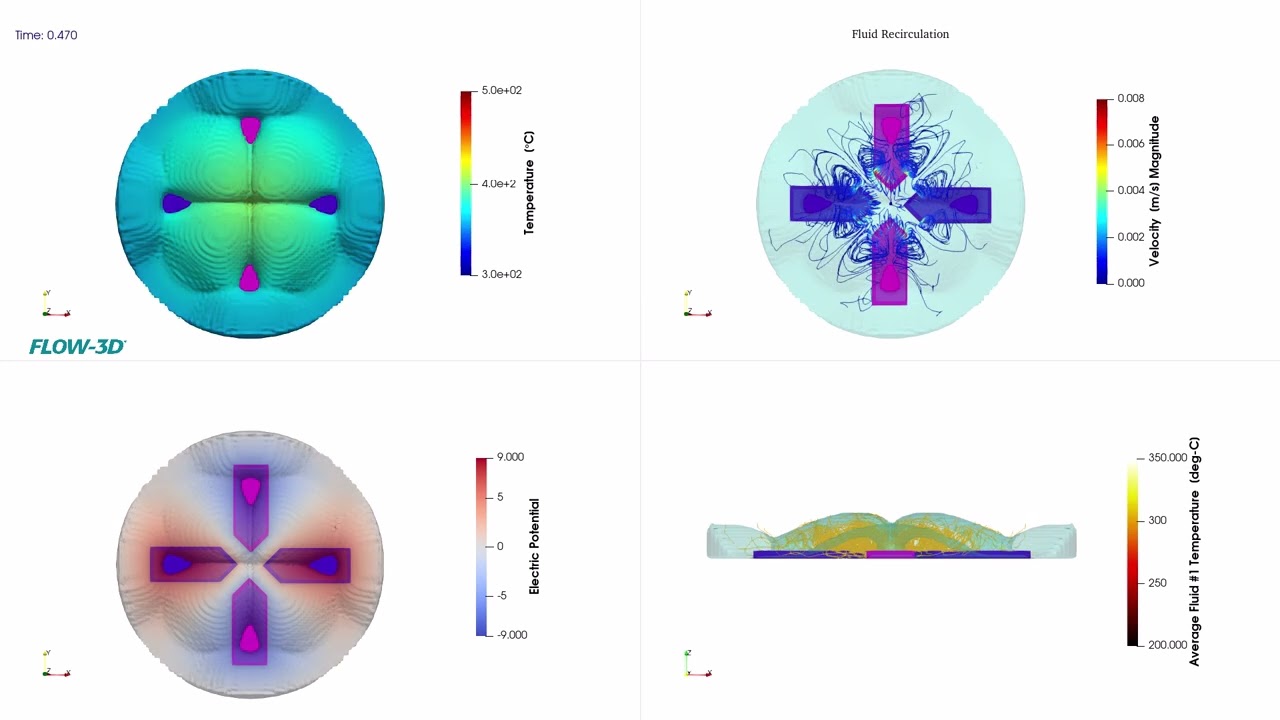
Joule heating occurs when an electric current passes through a conducting material, such as a fluid. At a microscopic level, Joule heating is caused by interactions between moving charged particles. Additionally, if the fluid is dielectric, polarization will happen in the presence of an electric field causing fluid flow. FLOW-3D can capture all such effects, which is demonstrated by the simulation, which highlights the software‘s ability to accurately capture electro-kinetics physics.
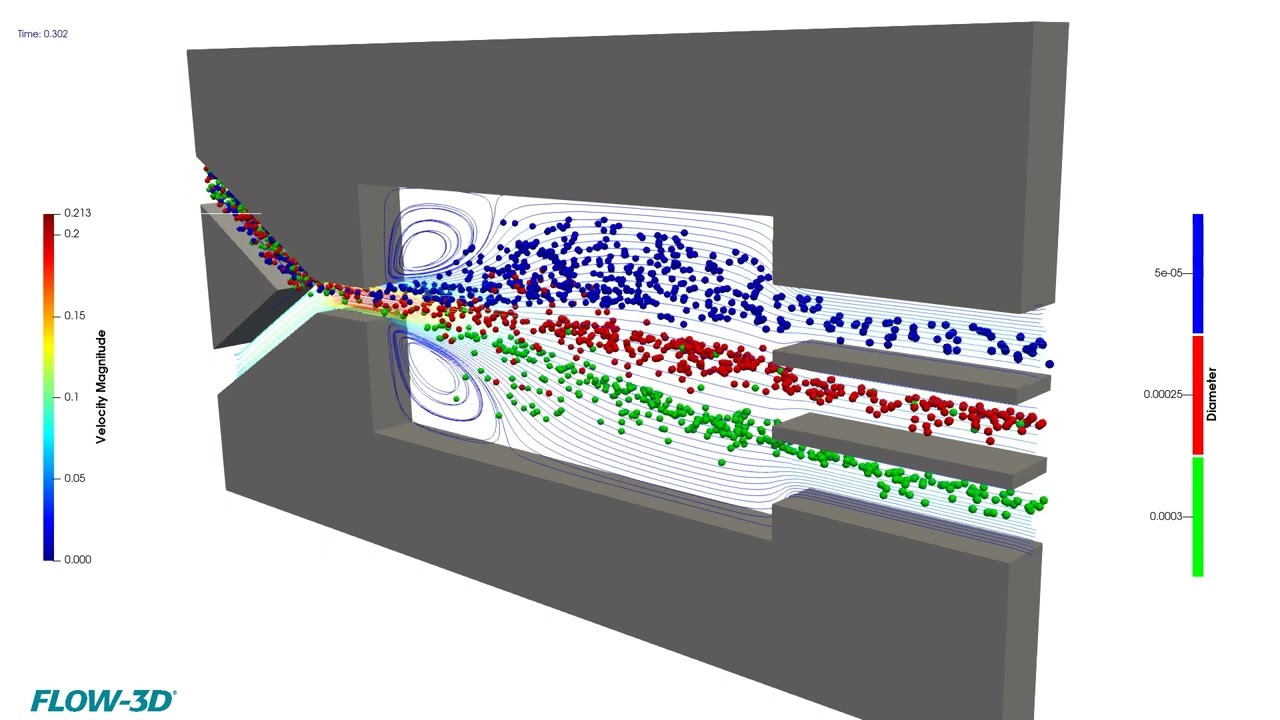
In this hydrodynamic microfluidic separation simulation, you can see particle sorting based on varying diameters. The technique works on the principle that a particle will follow a streamline. Particles with the smallest diameter (blue) get easily carried towards the top of the constriction and hence at the divergence follow the streamlines that diverge upwards. Particles with the largest diameter (green) stay their course and move towards the bottom of the constriction. Upon exiting the constriction, these particles follow the streamlines that diverge downwards.
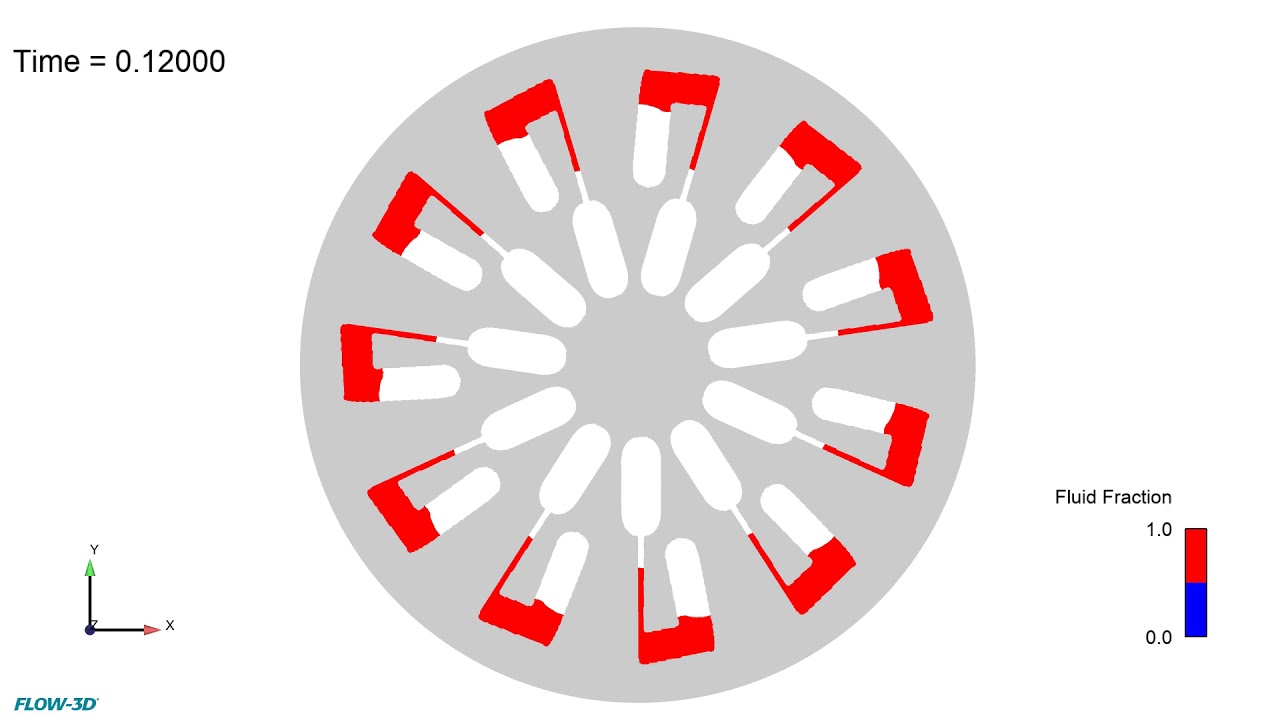
This FLOW-3D simulation shows the kinetic energy fluctuations for a microfluidic compact disc rotating at 1000 rpm. At this rotation speed, compared to the 7000 rpm speed (https://youtu.be/BfPC7UKf5vQ), steady state is delayed but with slowly fluctuating water levels.
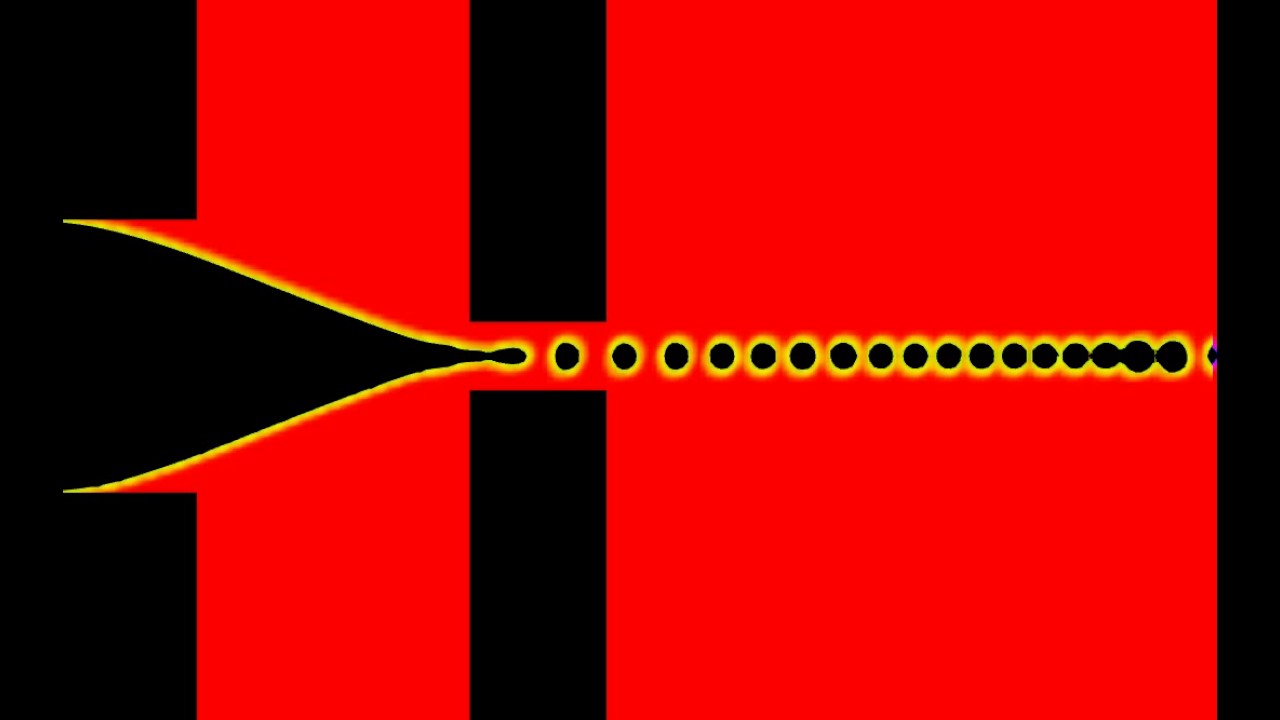
Flow focusing is a microfluidics technique to generate droplets or bubbles using hydrodynamics. In this video, FLOW-3D is used to simulate the flow focusing process.
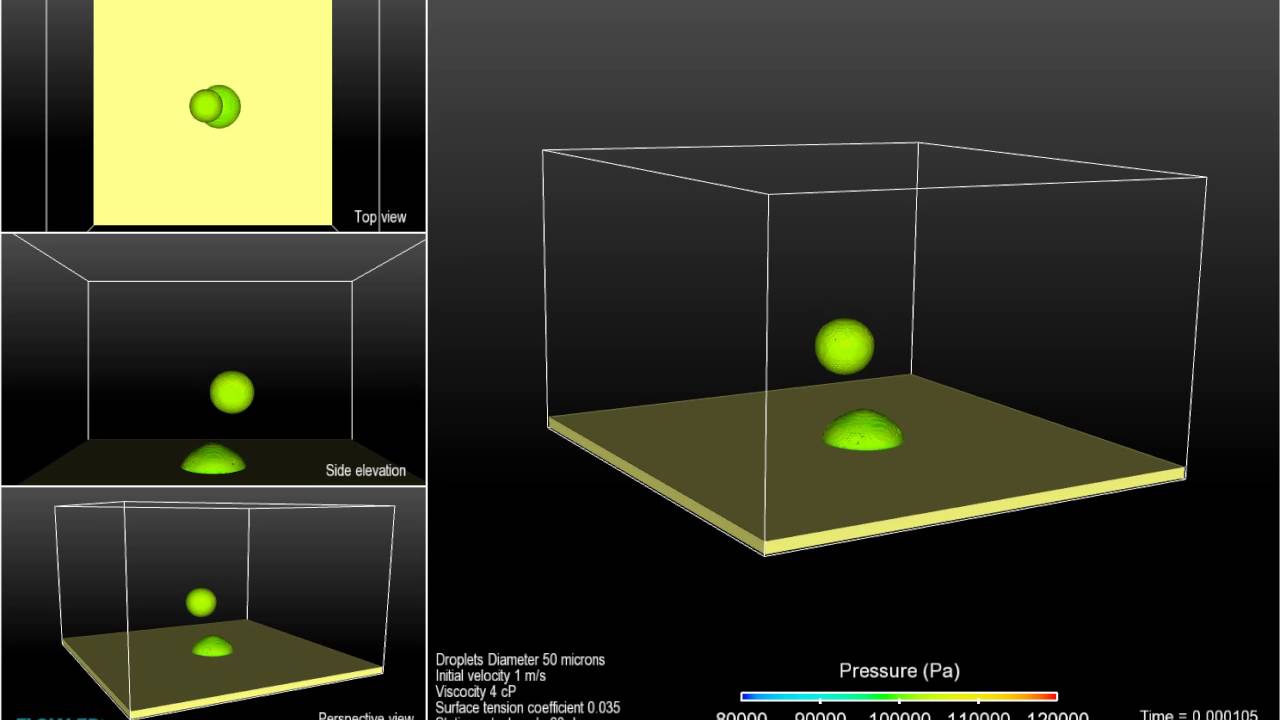
This FLOW-3D simulation demonstrates the impact of two droplets on a rigid surface.
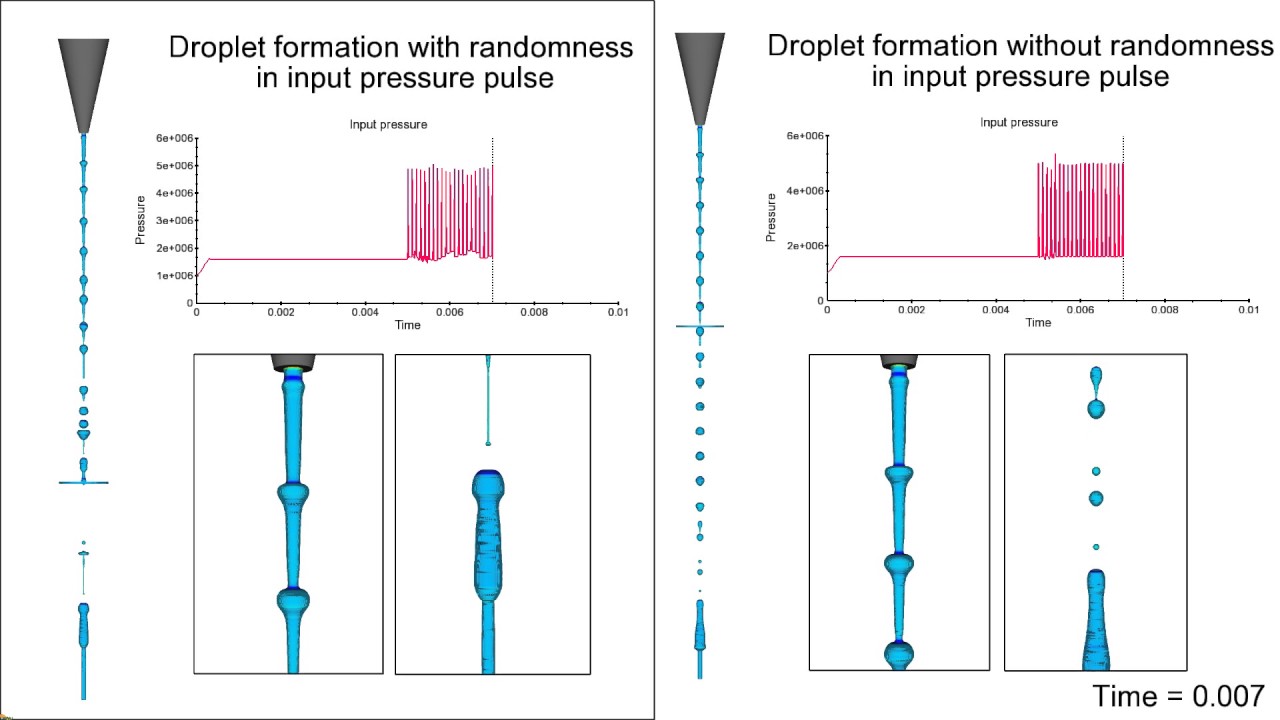
Continuous inkjet printing results comparison of an input pressure pulse with constant amplitude versus one with random fluctuations in the input pressure pulse.
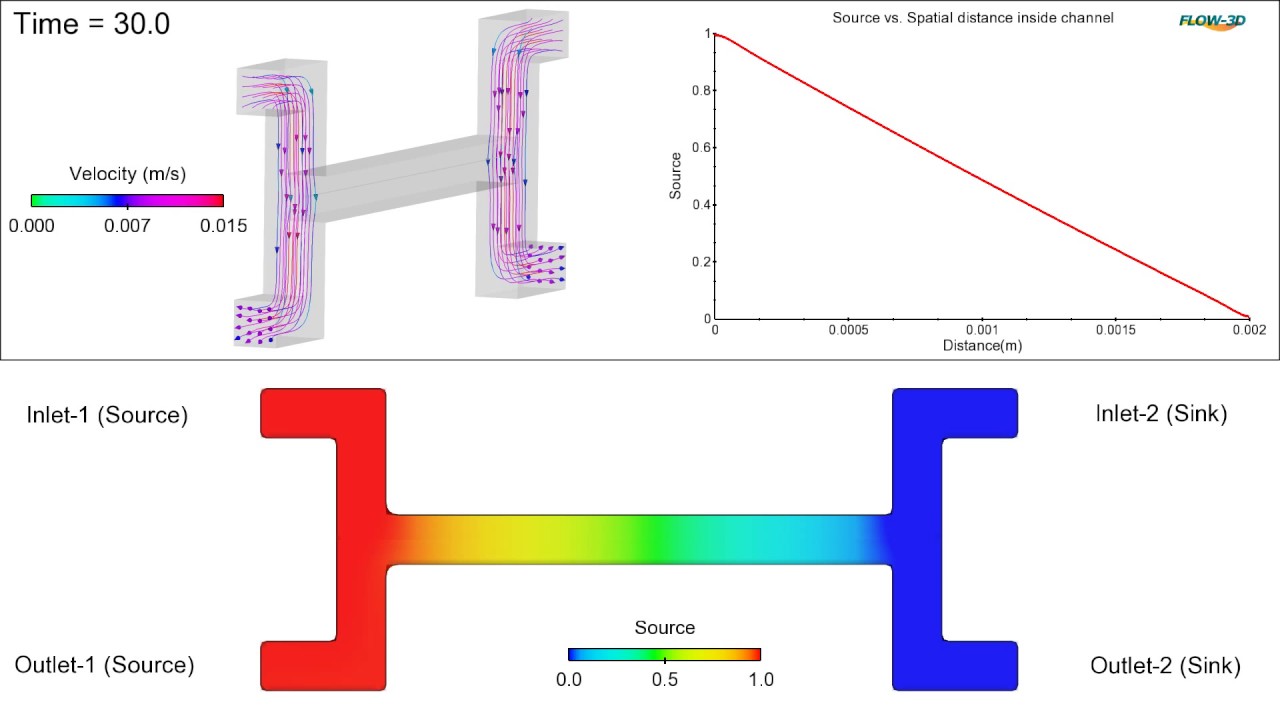
In this 1-D microfluidic palette simulation, a clean decoupling of the convective cells from the main central microchannel can be seen be through the plotted streamlines. The streamlines are all restrained to the convection units only and not even a single one leaks out into the microchannel, indicating excellent decoupling of convection and diffusion. The evolution of source concentration can be seen in the plot, which becomes visibly constant by the end of the animation. Read more at https://www.flow3d.com/microfluidic-palette-gradient-generator/
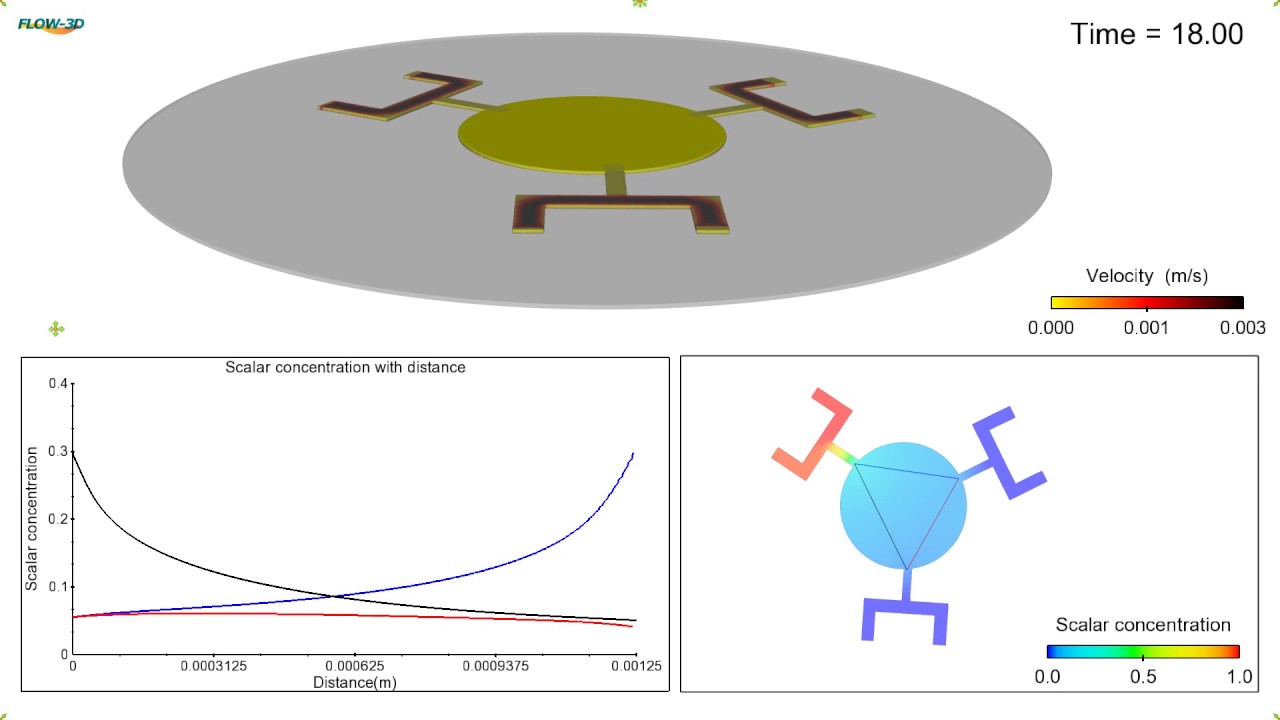
This simulation of a 2-D microfluidic palette demonstrates a spatio-temporal control on the generated gradients. The source and sink are rotated at an angular velocity. Also, after every t seconds, the active access port is deactivated and the next port is turned on. To see the live status of the diffusion inside the chamber, three line probes are placed in the simulation (marked in red, blue and black, respectively, in the bottom right window of the simulation). Read the full article at https://www.flow3d.com/microfluidic-palette-gradient-generator/
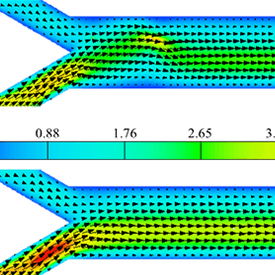
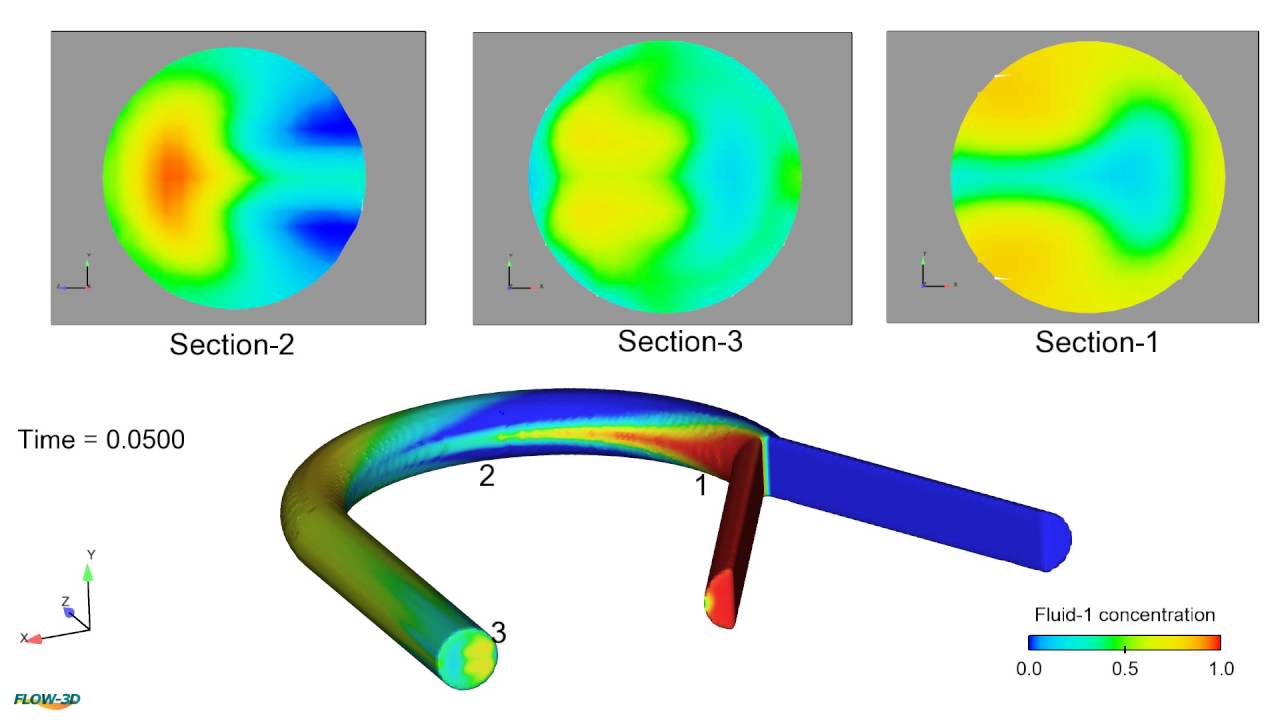
FLOW-3D simulation showing the mixing of the fluids coming in from two inlets. Iso-surfaces are plotted at the inlet, curved section and the outlet to highlight the formation of vortices and evolution of mixing over the length of the microchannel.