



Solve Production Issues
- Simulate existing welding processes and identify sources of defects and process sensitivities.
- Predict effects of varying welding recipes to improve joint quality while decreasing the cost and time spent running physical tests.
- Develop new weld schedules driven by CFD simulations for reduced production down time and risk of recurring quality issues.

Optimize Production
- Find optimal welding parameters using targeted optimization in FLOW-3D (x) to increase production without compromising joint quality.
- Perform sensitivity studies by varying process parameters such as power, speed, heat flux distribution, scan path, and material composition to identify parameters that can best optimize the process.
- Predict weld schedules that achieve specific part quality through defect mitigation, bead dimensions, surface finish, and thermal profiles.

Determine Manufacturing Requirements
- Use simulations to predict welding results at the bounds of your tolerance stack to ensure quality bonding, reduce the risk of assembly failures, and allow your engineers to develop requirements that result in successful production runs.
- Analyze the size and location of heat effected zones as well as thermal gradients and cooling rates to reduce probability of cracking.
- Meet electrical conductivity requirements in critical applications through predicted weld bead geometry and porosity levels.
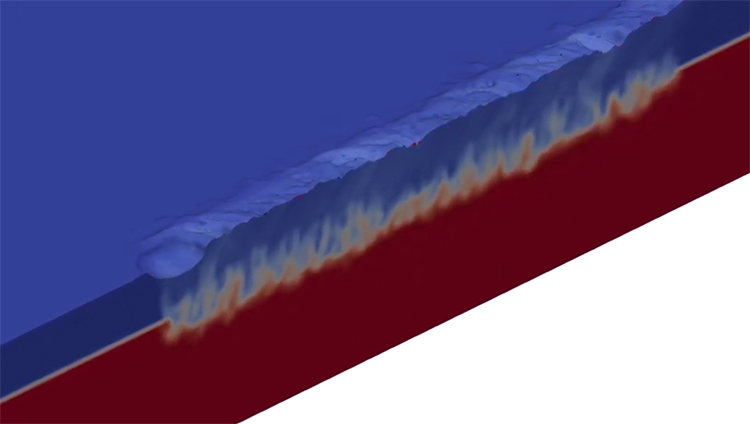
Test innovations
- Develop process parameters for joining dissimilar materials, custom alloys, or new materials.
- Explore scan strategies for joining parts with varying surface geometry such as tailor welded blanks.
- Study the effects of updated machine integrations such as the use of beam shaping technologies, pulse lasers, or multi-laser equipment.
Solve Production Issues
- Simulate existing welding processes and identify sources of defects and process sensitivities.
- Predict effects of varying welding recipes to improve joint quality while decreasing the cost and time spent running physical tests.
- Develop new weld schedules driven by CFD simulations for reduced production down time and risk of recurring quality issues.
Optimize Production
- Find optimal welding parameters using targeted optimization in FLOW-3D (x) to increase production without compromising joint quality.
- Perform sensitivity studies by varying process parameters such as power, speed, heat flux distribution, scan path, and material composition to identify parameters that can best optimize the process.
- Predict weld schedules that achieve specific part quality through defect mitigation, bead dimensions, surface finish, and thermal profiles.
Determine Manufacturing Requirements
- Use simulations to predict welding results at the bounds of your tolerance stack to ensure quality bonding, reduce the risk of assembly failures, and allow your engineers to develop requirements that result in successful production runs.
- Analyze the size and location of heat effected zones as well as thermal gradients and cooling rates to reduce probability of cracking.
- Meet electrical conductivity requirements in critical applications through predicted weld bead geometry and porosity levels.
Test innovations
- Develop process parameters for joining dissimilar materials, custom alloys, or new materials.
- Explore scan strategies for joining parts with varying surface geometry such as tailor welded blanks.
- Study the effects of updated machine integrations such as the use of beam shaping technologies, pulse lasers, or multi-laser equipment.


