


Continuous Casting Playlist

0:07
0:59
0:09

0:41

0:21
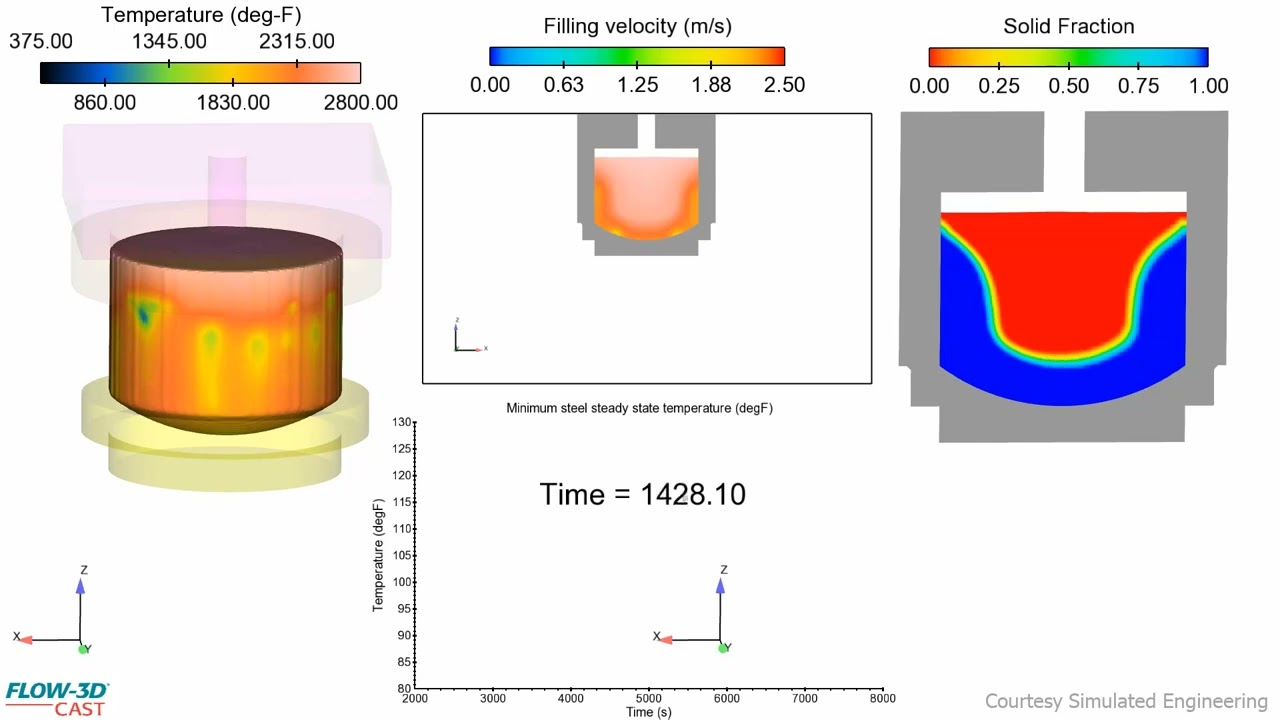
This FLOW-3D CAST simulation using the Continuous Casting Workspace shows adequate heat transfer in the transition zone to maintain the thermal energy required for molten metal to solidify and reach steady state. The simulation also shows die and metal temperatures, state of solidifying metal in transient zone and plots of thermocouple temperatures, which provide further insight into the continuous casting process.
Here, FLOW-3D CAST demonstrates the complex and controlled process of DC casting, computing adequate heat transfer, flow velocities and solidifying billet movement. The liquid-to-solid transition or mushy region within the mold is of particular interest to help design inlet flow, alloy segregation and heat transfer. The varying heat transfer through water cooling, spray cooling and residual stress developed in solidified billet is also crucial in manufacturability, production and efficiency of the process. Simulation with FLOW-3D CAST allows the flexibility required to accurately engineer the DC casting process.
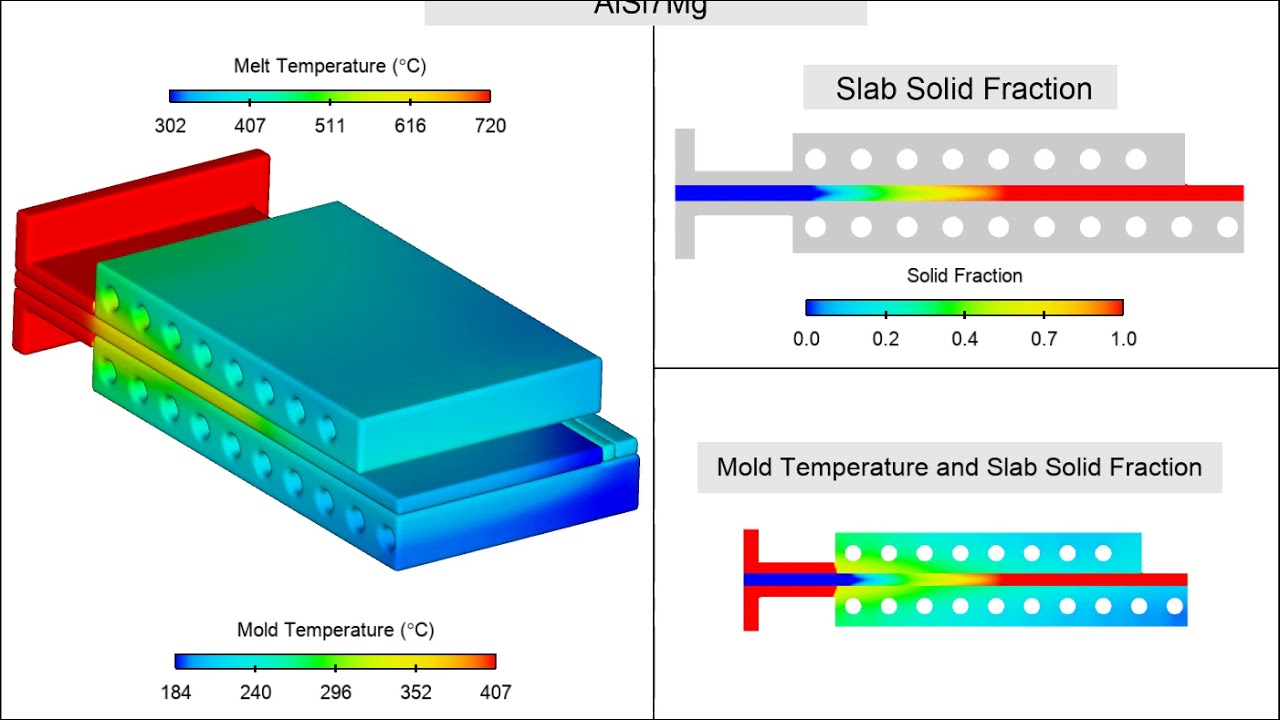
The goal of this simulation is to determine the cooling required to maintain a stable solidification profile during the continuous casting of Aluminum A356 plates. Melt is introduced into the process through a calcium silicate nozzle. Copper-Cobalt-Beryllium molds on both sides of the melt contain cooling channels to draw heat from the melt. The solidifying plate is drawn from the mold at a rate of 8 mm/sec.
This FLOW-3D CAST simulation represents a direct chill continuous casting of a 0.8 m diameter cylindrical billet of bronze. The starter block, made of H13 steel, is withdrawn at a rate of 18 mm/min. A copper cooling jacket removes 200 kW of heat from the billet as it is withdrawn from the mold. Additional cooling is applied to the billet surface after it leaves the mold. The left shows the billet surface temperature, the middle shows the solid fraction distribution in the billet, and the right shows the temperature distributions in the melt and the mold, nozzle, cooling jacket, and starter block.
This continuous casting simulation of pure lead sheets using FLOW-3D CAST represents a cast iron drum rotating in a bath of molten lead at 673 C. The drum rotates at 4.5 rpm and is spray cooled on its interior to maintain a constant temperature.