




Metal Casting Simulation Playlist
0:10

0:07

0:11
1:25

0:22

0:19

0:12
0:13
0:17
0:07

0:35

0:16
0:41
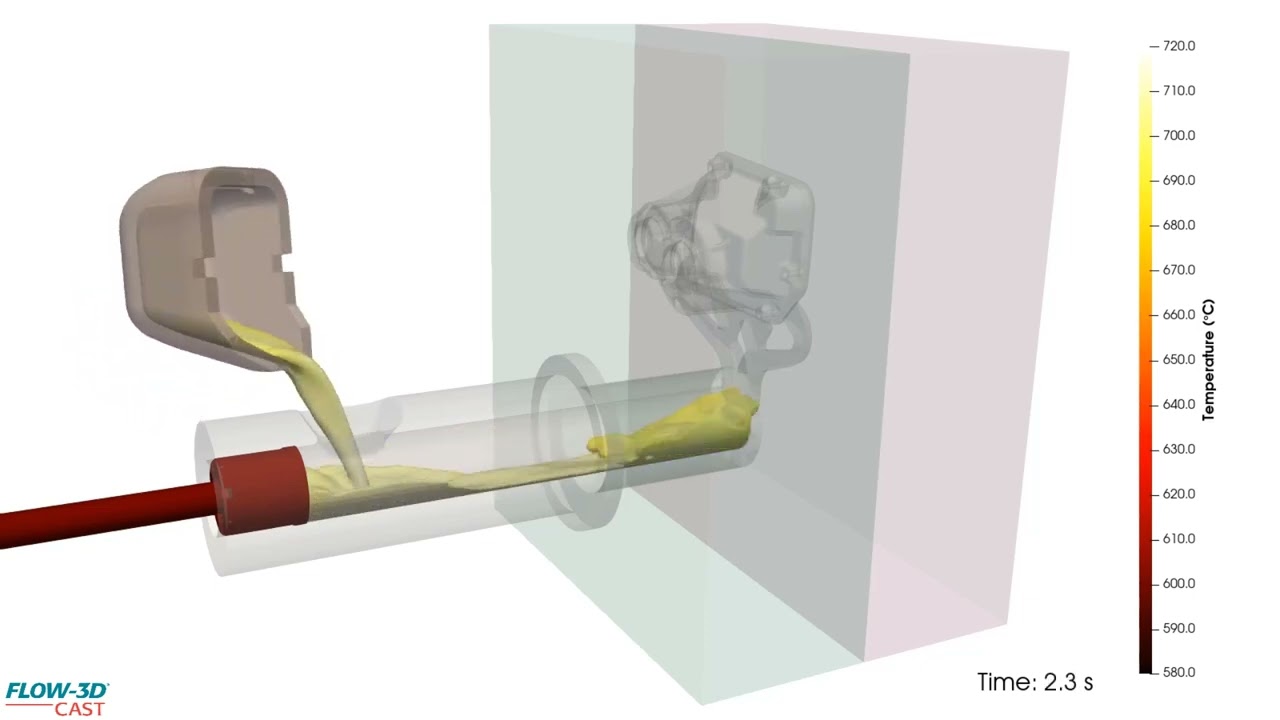
FLOW-3D CAST is used to accurately simulate the complex process of pouring into a shot sleeve using a ladle. Here, the thermal contours indicate pouring temperature vs. thermal loss in the dosing process. The wave propagation within the shot sleeve is accurately captured with the momentum transfer from pouring through ladle spout and the back fill from biscuit. This is crucial in computing the thermal loss and movement within the shot sleeve before the plunger pushes the metal into the casting. The heat generated in the shot sleeve can also be evaluated depending on duration of dosing and slow shot in tooling design for heating or cooling lines, thereby managing optimal thermal energy.
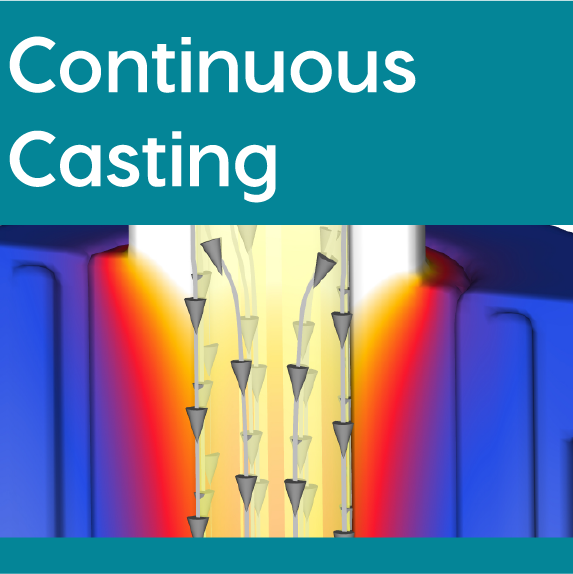
This FLOW-3D CAST simulation using the Continuous Casting Workspace shows adequate heat transfer in the transition zone to maintain the thermal energy required for molten metal to solidify and reach steady state. The simulation also shows die and metal temperatures, state of solidifying metal in transient zone and plots of thermocouple temperatures, which provide further insight into the continuous casting process.
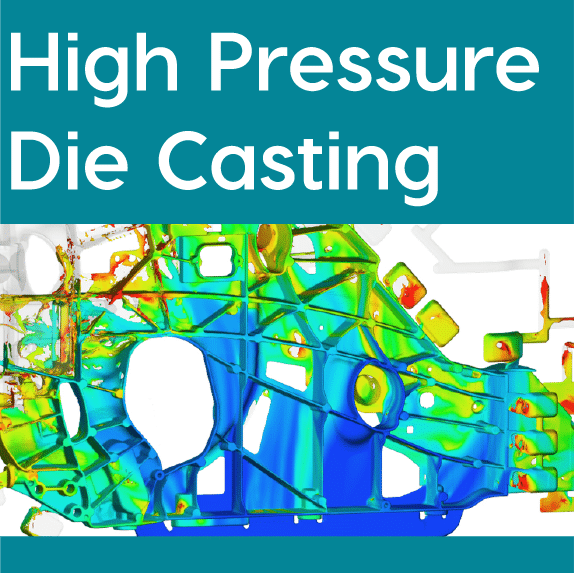
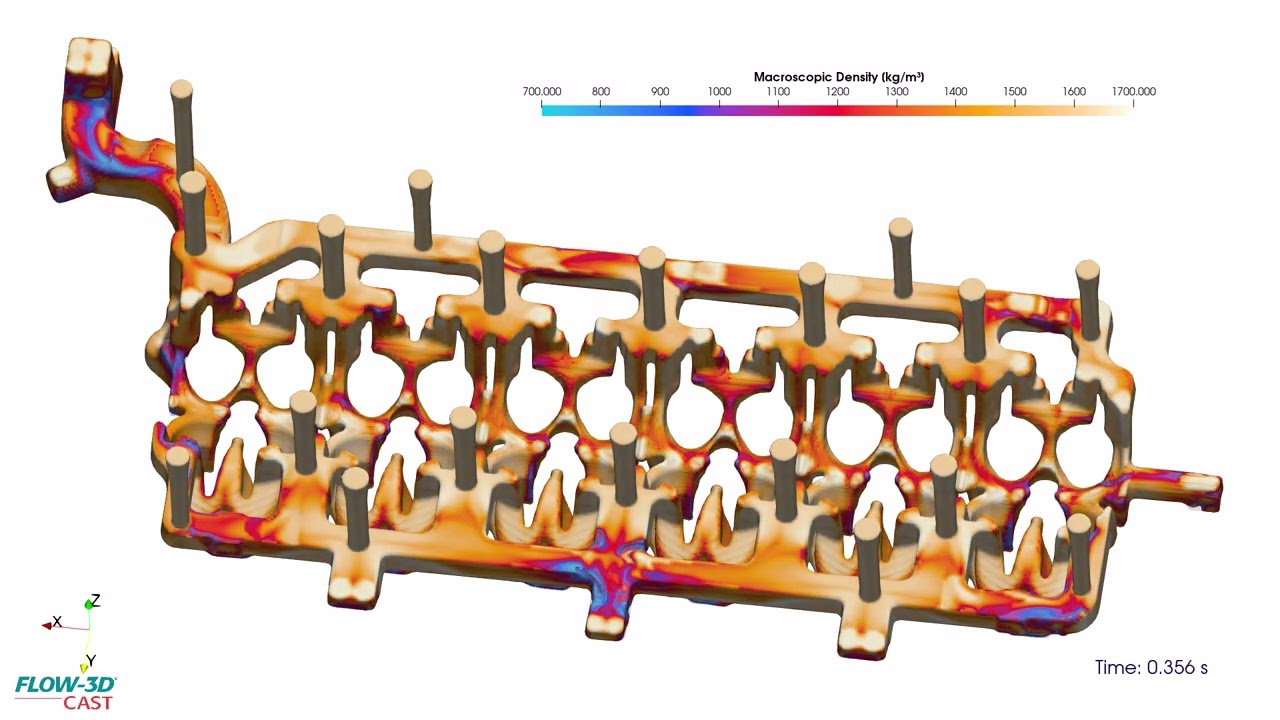
This high pressure die casting simulation shows filling of an aluminum alloy casting. FLOW-3D CAST is used to calculate the complex filling of a thin part and separation of the metal front as it climbs the two boss features in the casting geometry. The thermal contours indicate a 20degC drop in temperature between flow through ingates and complete fill of casting (without overflows). The illustrated free surface defect oxide contours identify areas where overflows can be added to remove oxides trapped in the metal. The animation showing pressure of gas trapped in the casting cavity is useful to see pressurization and last regions to fill, indicating the need for overflow vents to avoid gas porosity.
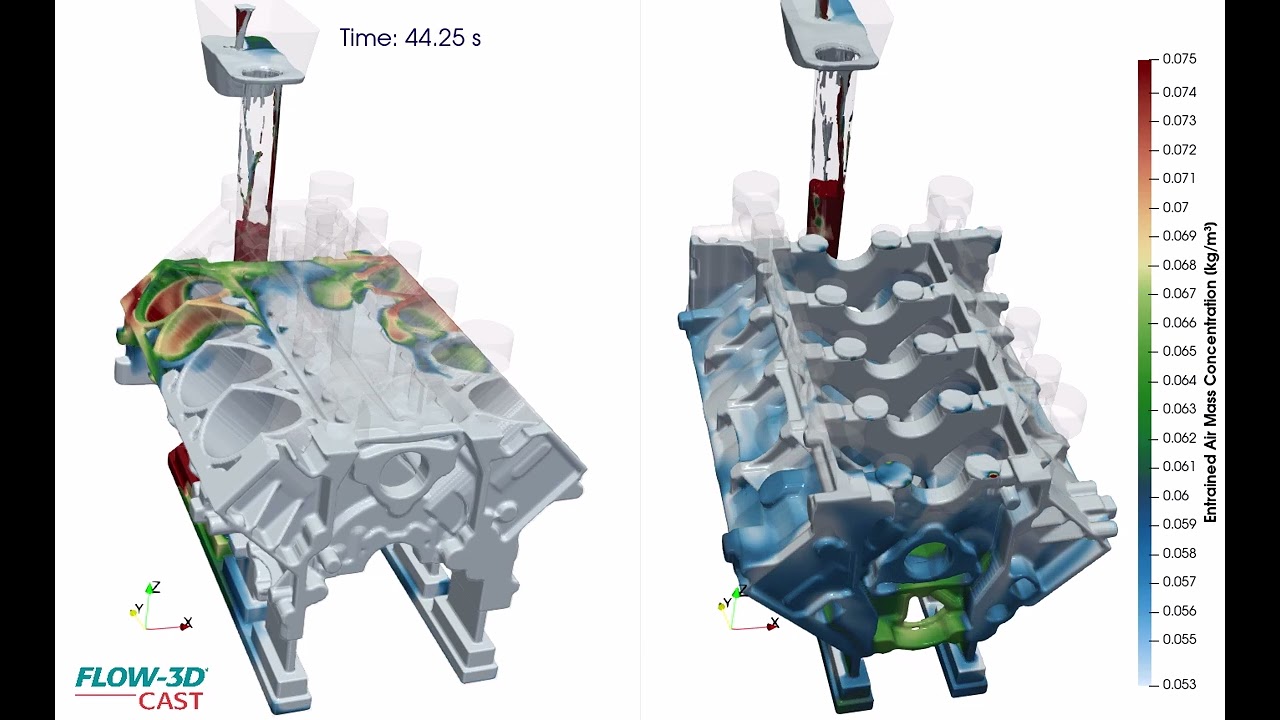
This simulated entrained air filling is a comparison of the casting with engine cylinders oriented up and down. The key observation here is that entrained air (gas porosity) collects towards the end of runner and backfills into the casting in addition to significant recirculation of air. Further, the sprue flow shows additional air building and transferring into the casting later in fill. While the orientation of cylinders downward helps in reducing the highest concentration of air in comparison to the cylinders up, the sprue and runner design leaves room for improvement.
FLOW-3D CAST offers a unique combination of accurate flow simulations, defect detection, optimization capabilities and support for large, complex castings, making it the ideal choice for the simulation of HPDC structural components. The modeling of the mold filling through the realistic movement of the plunger provides exact results of the melt temperature. This enables associated problems, such as cold running, to be predicted precisely.
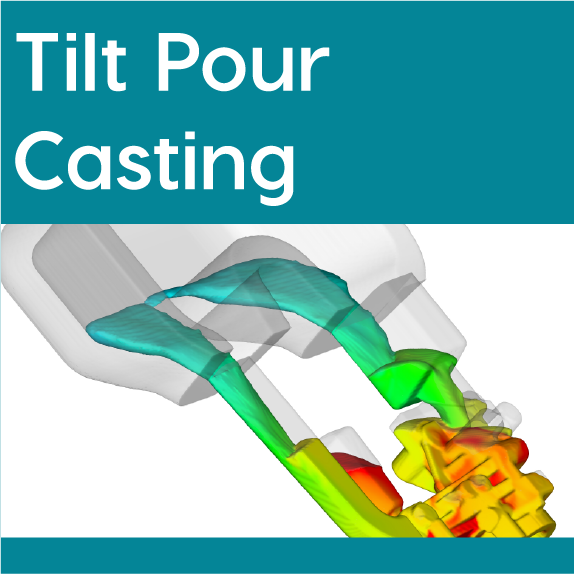
This is a three-part simulation setup in FLOW-3D CAST for a tilt pour aluminum casting of a piston. This simulation uses insulated risers and cooling channels. The first simulation is a thermal die cycling to find the steady state level of heat saturation in the mold. Once the thermal data is accessed, a filling simulation is done to access filling behavior and defects. Lastly, a solidification simulation is run to assess shrinkage porosity and microstructure. The NIRF model is implemented for fast and easy setup of the tilt pour process. Surface tension is modeled to be temperature-dependent. The rotation of the furnace is described as a moving object. The full chemistry solidification model provides accurate results of microstructure and mechanical properties.
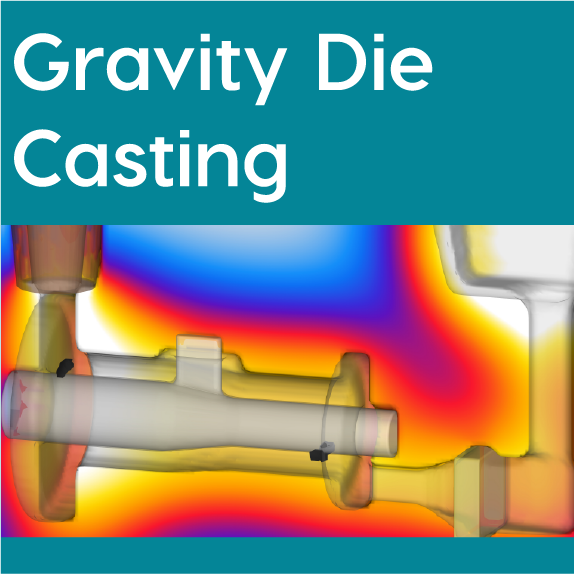
Courtesy of CM Tarrico, this is a gravity die casting simulation of two components in FLOW-3D CAST, showing local temperature distribution in the mold during filling. Based on the results, the TDC model can be implemented to condition the die for a solidification simulation to analyze porosity and other solidification-related defects.
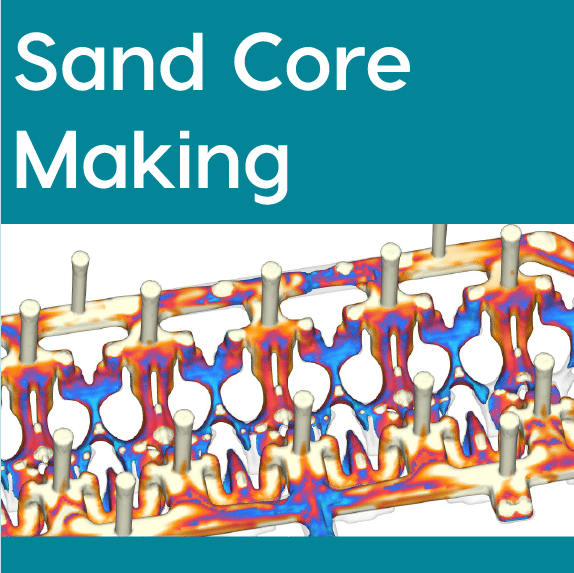
FLOW-3D CAST helps to establish robust process conditions and optimized solutions for sand core production including the shooting, gassing and curing of organic and inorganic binders for cold and heated core boxes. The animation shows the prediction of the filling patterns and sand packing densities during the shooting process. Based on these results, the number, dimensions, and positions of the shooting nozzles and core box vents can be optimized. By using FLOW-3D CAST to simulate this process, customers can produce flawless, high-quality sand cores.
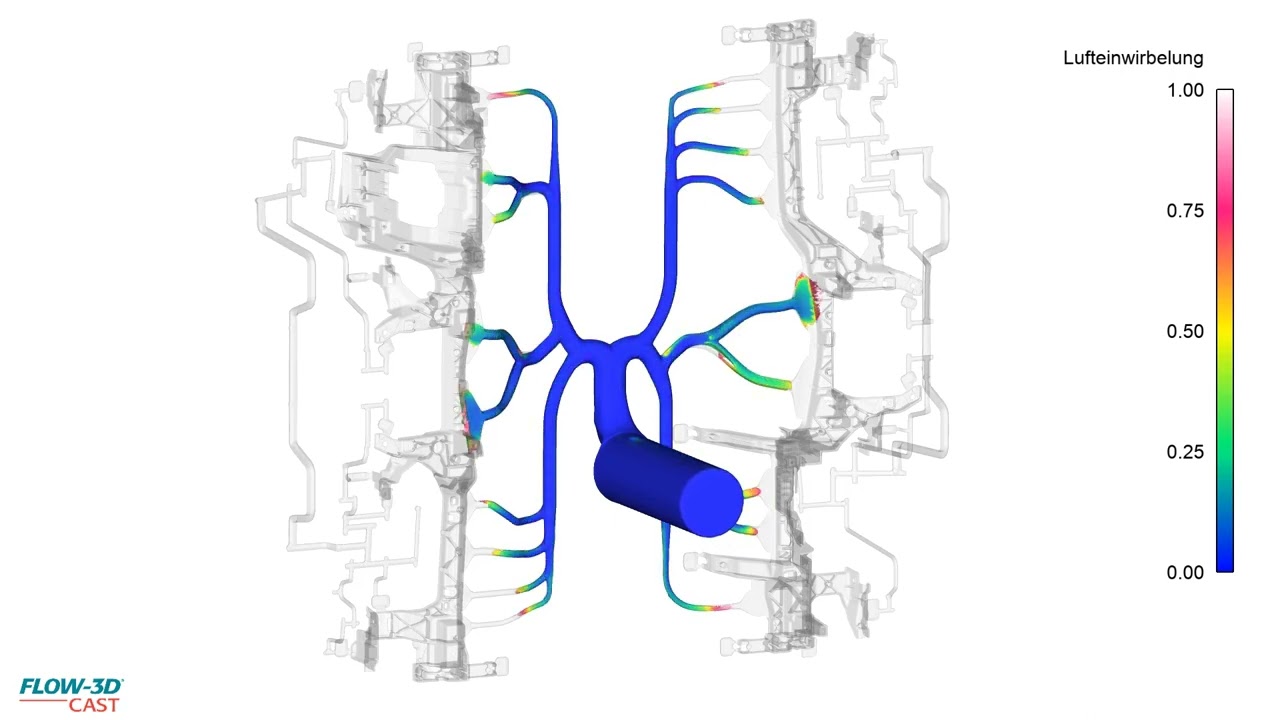
This FLOW-3D CAST simulation is a two-cavity high pressure die casting filling for an automotive instrument panel. The color shows air entrained in the metal as it violently moves through the cavity. Note that the movement of the piston in the slow stage of the filling is suboptimal since it traps a volume of air that is then pushed into the cavity.
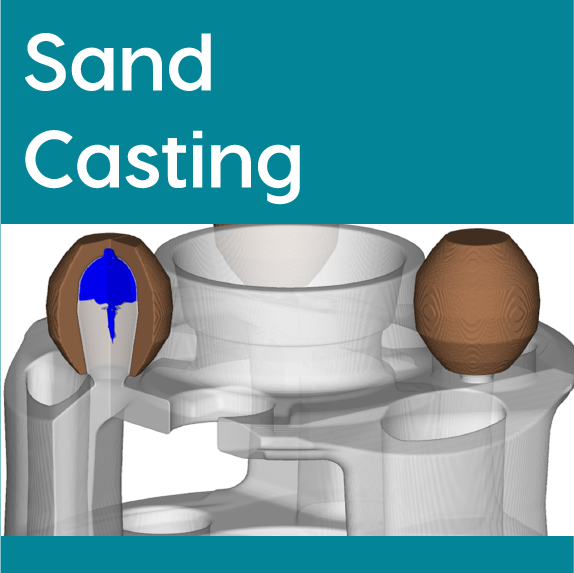
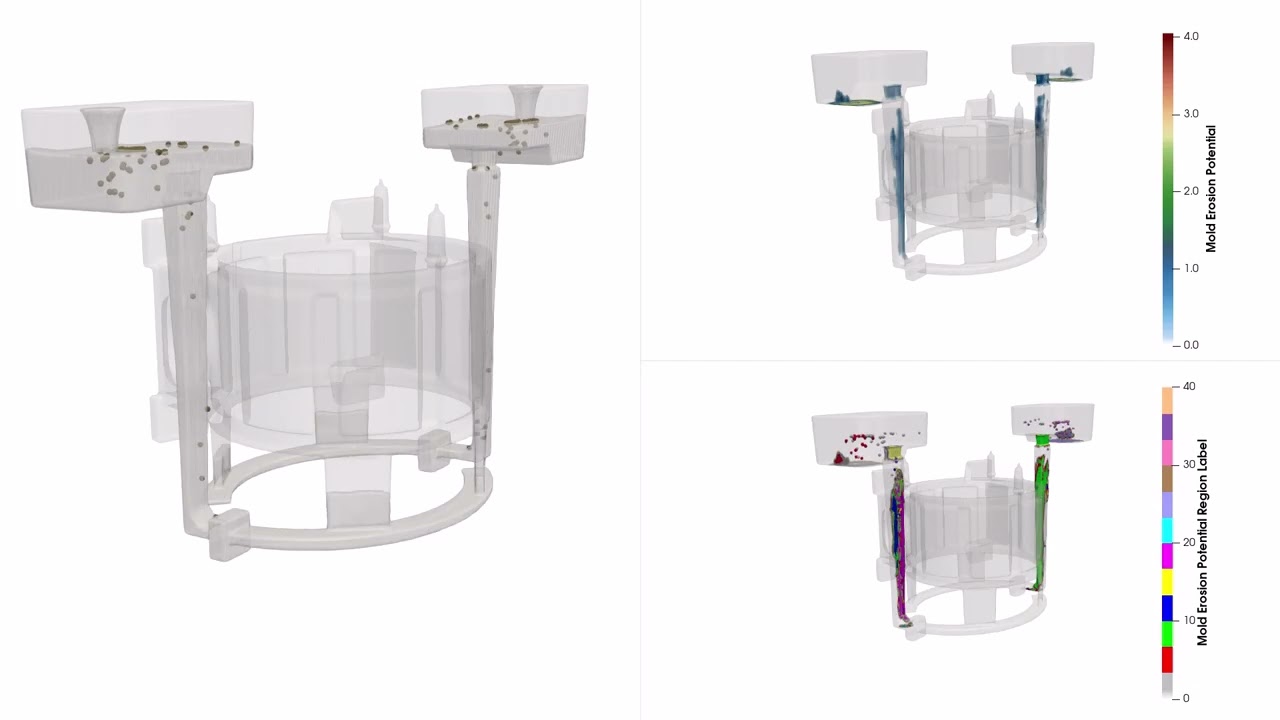
This FLOW-3D CAST simulation demonstrates the mold erosion calculation and sand inclusions generation/tracking for a gravity sand casting. Sand inclusions are generated at high mold erosion potential regions, where the mold will likely be damaged due to long exposure to high-velocity metal flow. However, the sand inclusions generated in the pouring basin and on the down sprue surface are eliminated by the filter at the bottom, and thus will not go into the casting. The sand inclusions generated in the runner after the filter may end up in the casting depending on the metal flow. The sand inclusions are marked by the mold erosion potential region label, which can be used to trace their origins.
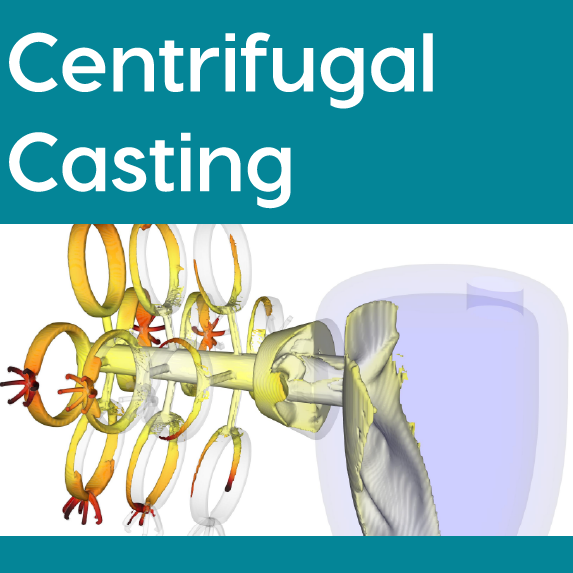
Platinum is poured into a ceramic investment flask to fill the sprue, runners and multiple rings in a jewelry tree casting. The pouring rate is varied to slowly fill the sprue, showing flow dynamics at the sprue bottom on impact and resulting turbulence entraining air. Solidification analysis follows end of fill to show shrinkage porosity and melt feeding.
For this validation, an aluminum casting was selected which showed significant porosity defects. The extent of the porosities meant that the casting would not fulfill the functional specification and hence would be rejected. In order to verify that FLOW-3D CAST can reliably predict such casting defects, the existing casting was simulated and the results compared with the real casting defects. The simulation shows the defect analysis which correctly reproduced the defects and their position.
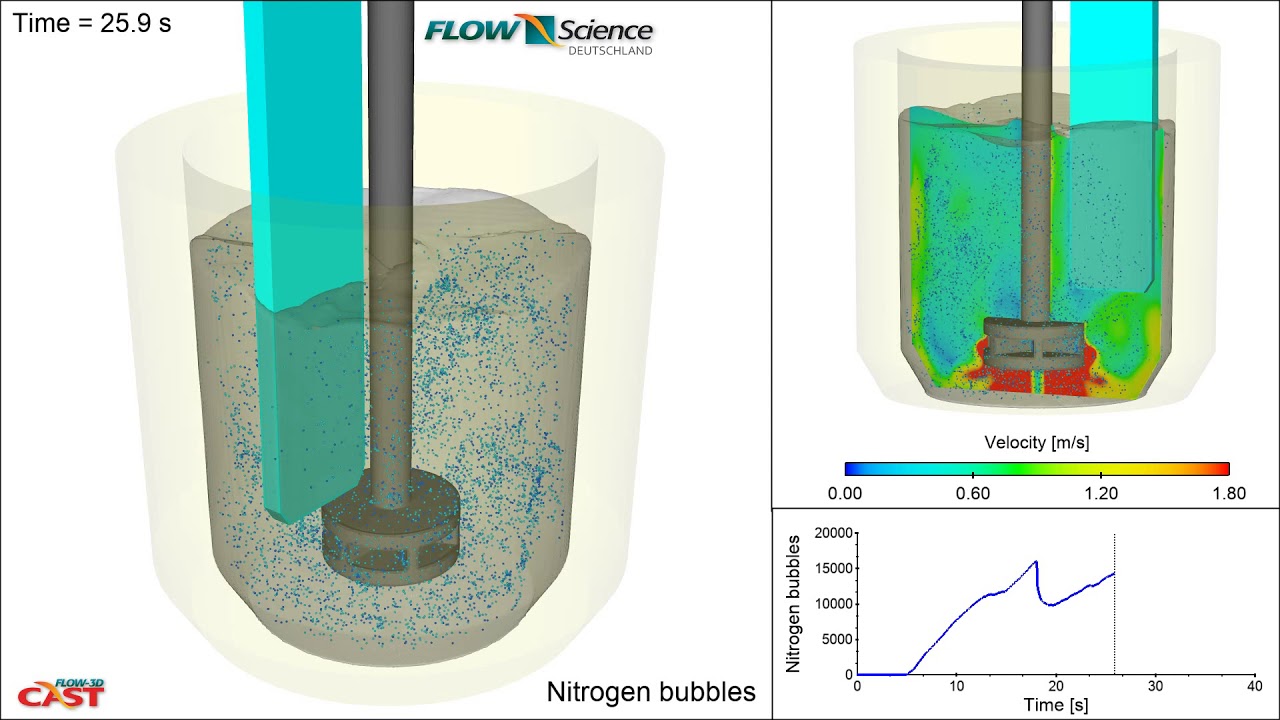
The mechanical properties of aluminum can be negatively affected by dissolved hydrogen in the metal. To mitigate this, a rotary degassing process introduces an inert purge gas (in this case, nitrogen) into the melt. The circulation created by the rotor allows the hydrogen to diffuse into the inert gas bubbles. FLOW-3D CAST allows the process engineer to model process parameters such as rotor design and speed to achieve optimal mixing and cast quality.


