What's New in FLOW-3D CAST 2025R1
FLOW-3D CAST 2025R1 empowers casting engineers to achieve better quality, efficiency and precision in complex non-ferrous castings. This release includes improvements to the solidification and shrinkage models, the shot sleeve model in HPDC, and the valve model.
Solidification shrinkage model improvements
This new release incorporates an improved solidification shrinkage model with revised porosity outputs in the new EXODUS format, allowing users to simplify the analysis and interpretation of porosity. Porosity outputs now include resolved shrinkage porosity, helping engineers better visualize leak paths.
Improved treatment of solidified metal in the shot sleeve
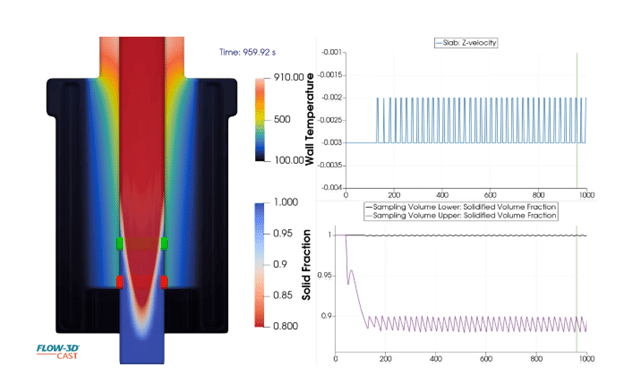
In high pressure die casting (HPDC), defects such as cold shuts and misruns in the finished casting can originate from early solidification in the shot sleeve. Users can now capture the movement of solidified metal in the shot sleeve with the porosity-based solidification model, providing a much more accurate thermal profile during fill.
Improved valve model
Valves and air vent components in FLOW-3D CAST are used to model venting systems in casting assemblies, which can be crucial for removing defects from the casting part. Users can now more accurately predict the final location of defects with the improved valve model by specifying a target volume of metal allowed to exit valves and vents.
This release of FLOW-3D CAST also incorporates an improved particle model interface and other usability improvements.
What's New in FLOW-3D CAST 2024R1
Additionally, we expanded the simple spray/die treatment model with an option to spray parting lines as well as the cavity, providing an easy and realistic representation of this style of die treatment, leading to better thermal predictions. Similarly, we now account for plunger motion during the thermal die cycling simulations, improving the accuracy of the thermal prediction.
Another development is designed to provide faster thermal solutions for early stage die design while still maintaining the accuracy of the solution. This is activated with a new heat transfer mode for geometry types.
Two new outputs were added to FLOW-3D CAST 2024R1. The first is the Specific heat transfer to mold which stores the rate of heat transfer into the mold and gives insight into the cooling power needed at different locations in the die. The second output shows the Cavitation load, to mark areas that are likely to have cavitation damage.
Finally, we made two adjustments to existing models to make them match user expectations more closely. First, we made valves apply to the nearest open volume, eliminating the possibility that the approximation of the die surface could inadvertently disable the valve. The second adjustment was to provide a more realistic default limit on the plunger acceleration when using the model since the default value could result in a noisy result.
What's New in FLOW-3D CAST 2023R2
New results file format
Hydrostatic pressure initialization
New Thermal Die Cycling (TDC) model
What's New in FLOW-3D CAST 2023R1
Advanced features in FLOW-3D CAST 2023R1 allow users to:
- Optimize shot performance, including when making Giga-castings
- Address tooling wear
- Simulate advanced carbon and low alloy steel castings
- Account for the effects of macro-segregation
Plunger motion improvements
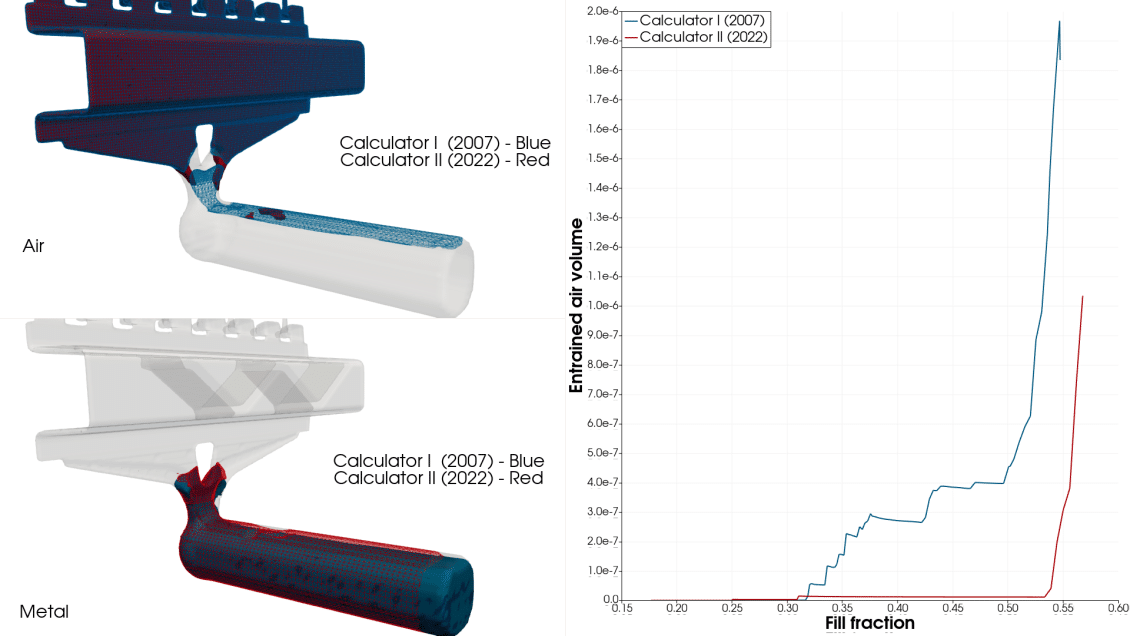
We have improved our slow shot calculator to improve accuracy, reduce air entrainment, and expand the range of validity to better handle low fill levels. We also streamlined the user interface, and this combined with the improved slow shot calculator delivers impressive results. You can now easily use data from the slow shot calculator in either plunger position or time-based definitions. The new calculator also provides refined shot profiles that significantly reduce the air entrained at the end of the slow shot.
Expanded PQ2 analysis
Large castings are computationally expensive, and Giga-castings can push a simulation software to its limits. Approximating the shot sleeve and plunger with a velocity boundary condition or metal input is a useful simplification to reduce runtime. However, without PQ2 analysis, it is not possible to know if the HPDC machine is running close to its limits and may not perform as expected, therefore threatening the quality of the part. We have addressed this issue by taking our very capable PQ2 analysis and applying it to metal inputs and velocity boundary conditions. This translates to significant reduction in turnaround times while still maintaining filling accuracy, even in the largest and most complex castings.
Mold erosion prediction
Casting molds and dies wear out for a variety of reasons, including mechanical stressors. Our existing shear load metric is helpful when studying this wear but until now has not accounted for impingement of the metal on the mold and has not been able to predict the final location of sand inclusions in sand casting molds. To address this issue, we added a new output to better understand this wear mechanism. The new output shows the regions where this type of erosion is likely as well as the predicted location of sand inclusions.
Die soldering prediction
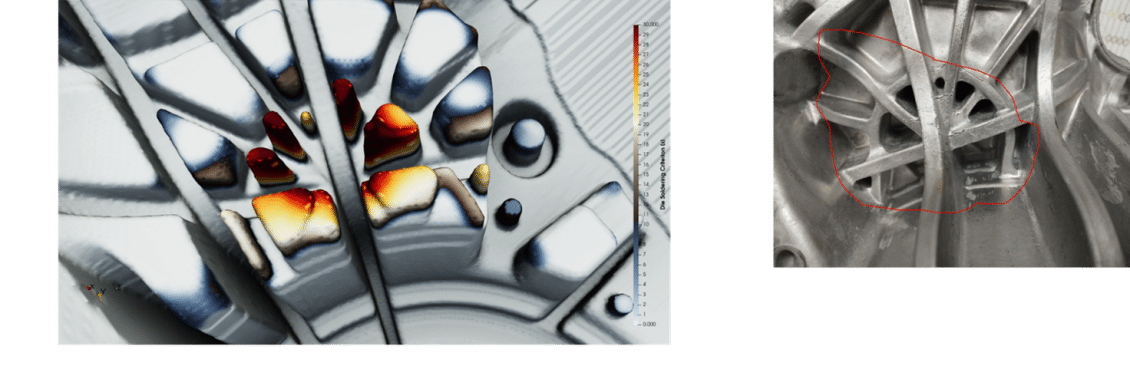
Permanent dies used in aluminum castings are subject to chemical wear as the aluminum in the melt bonds to the iron in the die, forming solder that affects the longevity and maintenance needs of the die, as well as part quality. The importance of this wear mechanism led us to build a model that predicts both the location and severity of the soldering.
Chemistry-based carbon and low alloy steel solidification model
The result of one of our longer-term development goals is a powerful, chemistry-based solidification model for carbon and low alloy steels that provide an accurate accounting of the precipitation reactions, solidification and remelting path, and microstructure features and defects. The model also accounts for the important three-phase peritectic reaction and corresponding defects that are associated with the large volume shrinkage due to the delta ferrite to austenite transition.
The model shows excellent agreement with experiments, and provides insights into nonintuitive, time-dependent behaviors, for example, why a hyper-peritectic alloy might develop regions of ferrite at the end of solidification.
Macro-segregation prediction
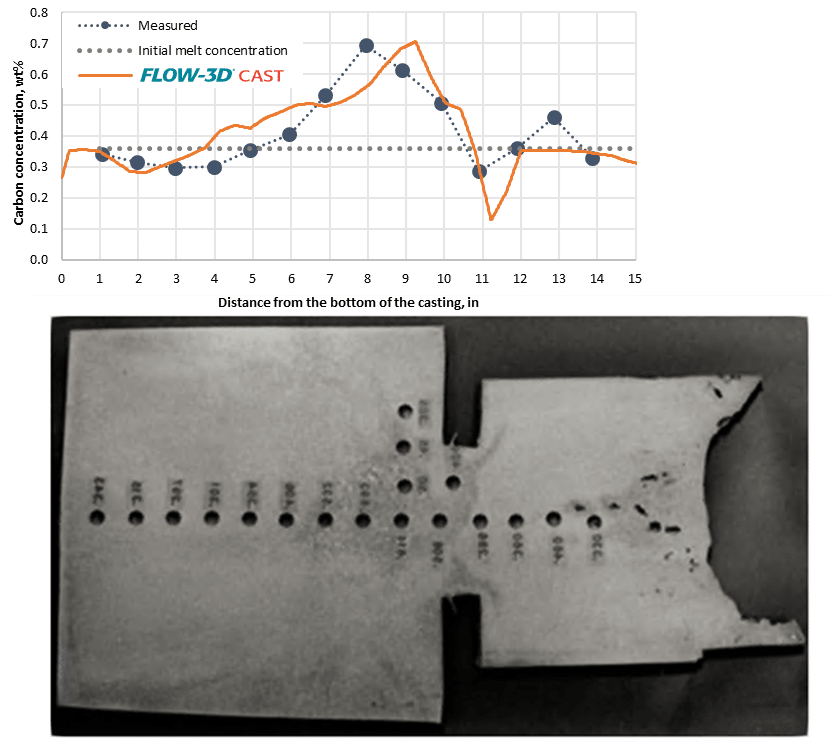
Macro-segregation can have an important impact on the quality and downstream processing of castings so we added that to our chemistry-based solidification models. The model predicts where macro-segregation-related defects may occur so you can anticipate and mitigate them before casting.
What's New in FLOW-3D CAST 2022R2
With the release of the FLOW-3D CAST 2022R2 product family, Flow Science has unified the workstation and HPC versions of FLOW-3D CAST to deliver a single solver engine capable of taking advantage of any type of hardware architecture, from single node CPU configurations to multi-node parallel high performance computing executions. Additional developments include a new log conformation tensor method for visco-elastic flows, continued solver speed performance improvements, advanced cooling channel and phantom component controls, and improved entrained air functionalities.
Unified solver
We migrated our FLOW-3D products to a single, unified solver to run seamlessly on local workstations or on high performance computing hardware environments.
Many users run their models on laptops or local workstations, but in addition run larger models on high performance computing clusters. With the 2022R2 release, the unified solver allows users to exploit the same benefits of OpenMP/MPI hybrid parallelization from HPC solutions to run on workstations and laptops.
Solver performance improvements
Multi socket workstations
Multi socket workstations are now very common and capable of running large simulations. With the new unified solver, users using this type of hardware will generally see performance gains from being able to run models taking advantage of OpenMP/MPI hybrid parallelization that used to be only available on HPC cluster configurations.
Low level routines improved vectorization and memory access
Performance gains on the order of 10% to 20% have been observed for most test cases, with some cases yielding run-time benefits in excess of 20%.
Refined volumetric convective stability limit
Time step stability limit is a major driver in model runtime, with 2022R2, a new time step stability limit, 3D convective stability limit, is available in the numerics widget. For models that are running and convection limited (cx, cy, or cz limits) the new option has shown typical speed-ups on the order of 30%.
Pressure solver pre-conditioner
In some cases, for challenging flow configurations, run times can be drawn out due to excessive pressure solver iterations. For those difficult cases, with 2022R2, when a model iterates too heavily, FLOW-3D automatically activates a new pre-conditioner to help with pressure convergence. Tests have improvements in runtime anywhere from 1.9 to 335 faster!
Log conformation tensor method for visco-elastic fluids
A new solver option for visco-elastic fluids is available to our users, and is particularly effective for high Weissemberg numbers
Active simulation control extensions
Active simulation control functionalities have been extended to include phantom objects, commonly used for continuous casting and additive manufacturing applications, as well as for cooling channels, used in casting and in many other thermal management applications.


What’s New – FLOW-3D CAST 2022R1
The new 2022R1 versioning of FLOW-3D products reflects Flow Science’s adoption of a synchronized release naming convention for FLOW-3D, FLOW-3D CAST and FLOW-3D HYDRO. 2022R1 represents the transition to a unified code base for FLOW-3D products. This important evolution will allow users access to the latest developments as soon as they are ready, at a more frequent product release pace.
FLOW-3D CAST 2022R1 features expanded controls for Active Simulation Control, tabular properties that allow users to easily understand complex dependencies without the need to fit data to a curve, and new outputs for identifying filling defects such as local filling velocity, time and temperature.
Expanded Controls for Active Simulation Control
Active Simulation Control (ASC) is very useful for controlling simulations based on flow information at probes. In this release, ASC now includes controls based on flow information from General History data, Flux Surfaces, and Sampling Volumes.
Investment Casting Example
- Metal source control (on/off) was based on probe-based data
- Metal source control can now be based on the fill fraction of the part volume: more robust control (not subject to splash)
- Termination condition can now be based on fill fraction of sampling volume
This video demonstrates Active Simulation Control being used to increase data output frequency when fast shot begins so that flow details can be captured. Flux surfaces are placed at the gates to measure the average velocity. When the average velocity exceeds 35 m/s, Active Simulation Control sets the output frequency to 0.0007 seconds for the duration of the simulation.
Tabular Properties
Material properties such as viscosity and surface tension are dependent on flow conditions such as temperature, strain rate, and possibly scalar quantities such as contaminants. Fitting these properties to functional forms requires complex curve fitting software, especially when the properties are dependent on more than one independent variable. The new tabular properties feature allows users to define these properties in table form with up to two independent variables, eliminating the need for curve fitting. For example, surface tension can be tabulated from experimental data to describe a complex, non-linear dependency on surface contaminants such as surface oxides as well as temperature. Additionally, viscosity can be tabulated from experimental data to represent a dependency on shear rate and temperature.
New Outputs for Identifying Filling Defects
Three new filling criteria outputs are available to identify potential casting defects caused by mold filling characteristics.
- Local filling velocity indicates the velocity of the melt when it first arrives at a particular computation cell. This output provides a single, summary view of the velocity map of the entire casting at the end of filling.
- Local filling time shows the time difference between when the melt first arrives at a particular computation cell and the last time melt arrives. Large differences indicate areas with a higher likelihood of filling-induced defects.
- Local filling temperature indicates the temperature of the melt when it first arrives at a particular computation cell. Low values of local filling temperature indicate areas where cold shuts are likely to occur.
VOF to Particles
The accuracy and robustness of the sharp-interface tracking VOF methods in FLOW-3D have been enhanced by combing them with fluid particles. The new particle species, called VOF particles, are used in place of the VOF function to track small fluid ligaments and droplets in the computational domain,
achieving better conservation of fluid volume and momentum. Higher time steps size can also be expected in gravity-controlled processes. The VOF fluid is automatically converted to VOF particles at certain times and locations when certain conditions are met. The particle motion is then calculated using the Lagrangian particle model and the particles are converted back to the VOF representation upon reentering the fluid.
Time-dependent Valves
Valves are commonly used in casting simulations to represent overflows in HPDC. Valves can now be controlled based on time. This feature is useful for representing valves in vacuum systems.
Deprecated Mold Temperature
Deprecated mold temperature now represents a more realistic system where new geometry temperature is driven by the type of object.
What's New in FLOW-3D CAST v5.1
Flow Science is pleased to announce the release of FLOW-3D CAST v5.1. This release provides casters with a complete simulation tool for modeling all the casting processes commonly found in modern foundries. Highlights of the FLOW-3D CAST v5.1 release include new process workspaces for investment casting, sand core making, centrifugal casting, and continuous casting, an expansive database of exothermic risers, and a brand new, chemistry-based alloy solidification model.
A major development in FLOW-3D CAST v5.1 is our new, award-winning alloy solidification model. This ground-breaking achievement provides casters with the ability to predict casting strength characteristics and reduce material usage while still meeting product safety and performance requirements.
The new process workspaces greatly reduce simulation setup and results analysis time. The Investment Casting Workspace features a fast and accurate shell mold generation tool and a full radiation model. The Sand Core Making Workspace models sand core shooting as well as all the hardening processes. The Centrifugal Casting Workspace provides the most accurate simulation tool available for all centrifugal processes. Finally, the Continuous Casting Workspace simulates all continuous casting processes including direct chill.
Additionally, databases for heat transfer coefficients, air vents, HPDC machines, and risers provide information at the users’ fingertips. The new exothermic riser database along with the solidification hotspot identification tool lets users quickly and easily place an appropriately sized exothermic riser at locations where shrinkage is predicted to occur.
State-of-the-art Solidification Model
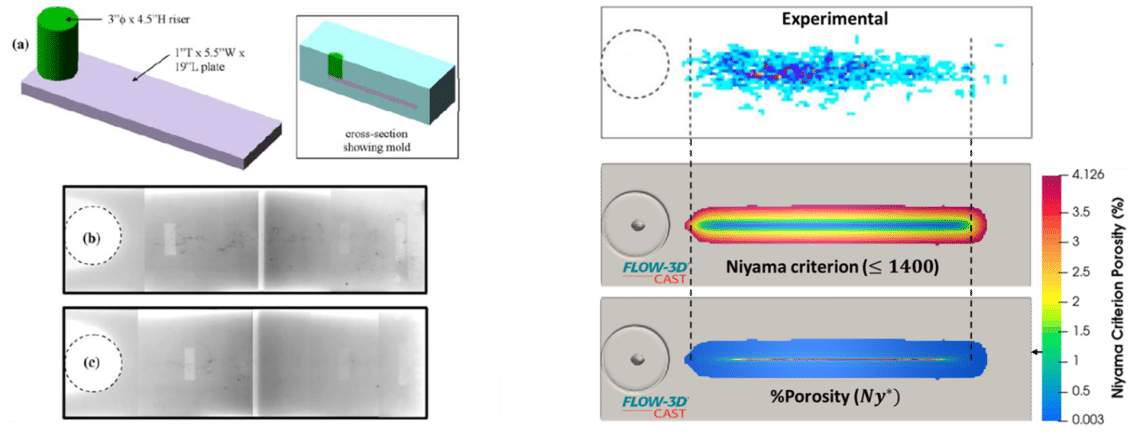
FLOW-3D CAST v5.1 features a new, state-of-the art, chemistry-based solidification model that advances solidification modeling into the next frontier of casting simulation – the ability to predict the strength properties of castings. Using only readily-available chemical compositions of alloys, users will be able to determine properties such as ultimate tensile strength, elongation, and thermal properties such as thermal conductivity. Additionally, the new solidification model provides output such as the dimensionless Niyama criteria and micro-porosity for more accurate assessments of porosity issues.
Many factors affect the mechanical properties of a casting. These properties are primarily determined by the microstructure which is in turn determined by factors such as the solidification rate, segregation rate, and nucleation. Using the new solidification model, process designers can determine the effect of various process parameters and alloy compositions on the mechanical properties to optimize the performance of their castings to produce the highest quality, safest products possible.
Investment Casting Workspace
The Investment Casting Workspace is a streamlined tool for simulating investment casting processes such as filling, solidification (with either static or moving shell molds), and cooling. A shell mold creation tool allows users to quickly and reliably create a shell mold of any thickness. A wide range of controls are available for generating radiating clusters, computing view factors of participating radiating surfaces and reducing computational overhead. In castings such as turbine blades, where grain growth is controlled by directional solidification, a moving oven with a hot upper section separated by a baffle from a cooler lower section can be modeled.
Continuous Casting Workspace
The Continuous Casting Workspace is a streamlined package that delivers the tools needed to model continuous billet casting and direct chill continuous casting, so casting engineers can improve their designs quickly and efficiently. Process parameters such as mold and billet cooling requirements, melt flow rate and superheat, and mold geometry can be analyzed and adjusted to minimize defects.
Centrifugal Casting Workspace
The Centrifugal Casting Workspace is an easy-to-use tool for simulating horizontal and vertical centrifugal casting, semi-centrifugal casting, and centrifuge casting. Within the process workspace, users will find all the tools they need to model their centrifugal casting process. Spinning molds and rotating meshes provide users with the flexibility to model any mold motion imaginable, as well as ladle pouring.
Cylindrical meshing offers the greatest flow modeling accuracy possible. Multi-block meshing provides even more detail to areas of high shear and large temperature gradients. Process-related defects such as excessive dross due to raining, or air entrainment during fill can be simulated. Process parameters such as mold preheat temperature, cooling requirements, and spin rates can be analyzed.
Sand Core Making Workspace
The Sand Core Making Process Workspace provides an easy-to-use tool for modeling the shooting and hardening of sand cores. Users can model the shooting of a wide range of sand and binder combinations to predict how a core box fills, locate regions where inadequate filling occurs, and then place and size air vents to improve filling in those regions. All core hardening processes can be modeled including cold box, hot box, and inorganic processes.
Core Hardening Processes Modeled
Cold Box
In the Cold Box process, gassing of sand cores with amine gas can be simulated. The placement of appropriately sized air vents is essential to ensure that the concentration of amine gas throughout the core is adequate to harden the core.
Hot Box
The Hot Box hardening process uses energy from the heated core box to heat the shot sand core.
Inorganic
The Inorganic hardening process uses hot, relatively dry air blown through the shooting inlets to dry the binder. As hot air is passed through the core, the binder is evaporated and is carried out of the core box through the air vents. Proper sizing and location of air vents ensures that enough air flows through all regions of the core.
Air vent database
A wide variety of air vents are available in FLOW-3D CAST’s air vent database.
Exothermic Sleeves
A common issue in large castings is shrinkage in solidifying regions due to inadequate feeding of liquid metal. The solution to this problem is to attach risers to the casting where hot spots are located so that the solidifying regions can pull liquid metal. The hot spot feature in FLOW-3D CAST provides a quick indication of the hot spot locations as well as the thermal modulus of the hot spot.