


Rivers & Environmental

0:25

0:31
0:36
0:29

0:21

0:23

0:35
0:33
0:31
0:17
0:21
0:31

0:16
0:21
0:14
0:41
0:15
This FLOW-3D HYDRO simulation of a lock demonstrates the downstream flushing strategy designed to keep invasive species out of the lock before opening: note the high velocity downstream of the lock (right). Courtesy of AnchorQEA.
Culverts can disrupt natural stream flows and create barriers for fish due to high velocities, inadequate flow depths, and outlets perched higher than the natural streambed. CFD modeling can help an engineer create a more fish-friendly culvert as part of a new design or a retrofit. In this FLOW-3D HYDRO example, a dual-barrel culvert has an offset fishway design on one side and a flat slope on the other. Using CFD, you can fine tune the fishway design to meet the hydraulic needs of your local fish species by gaining detailed insights on the hydraulic performance of your design
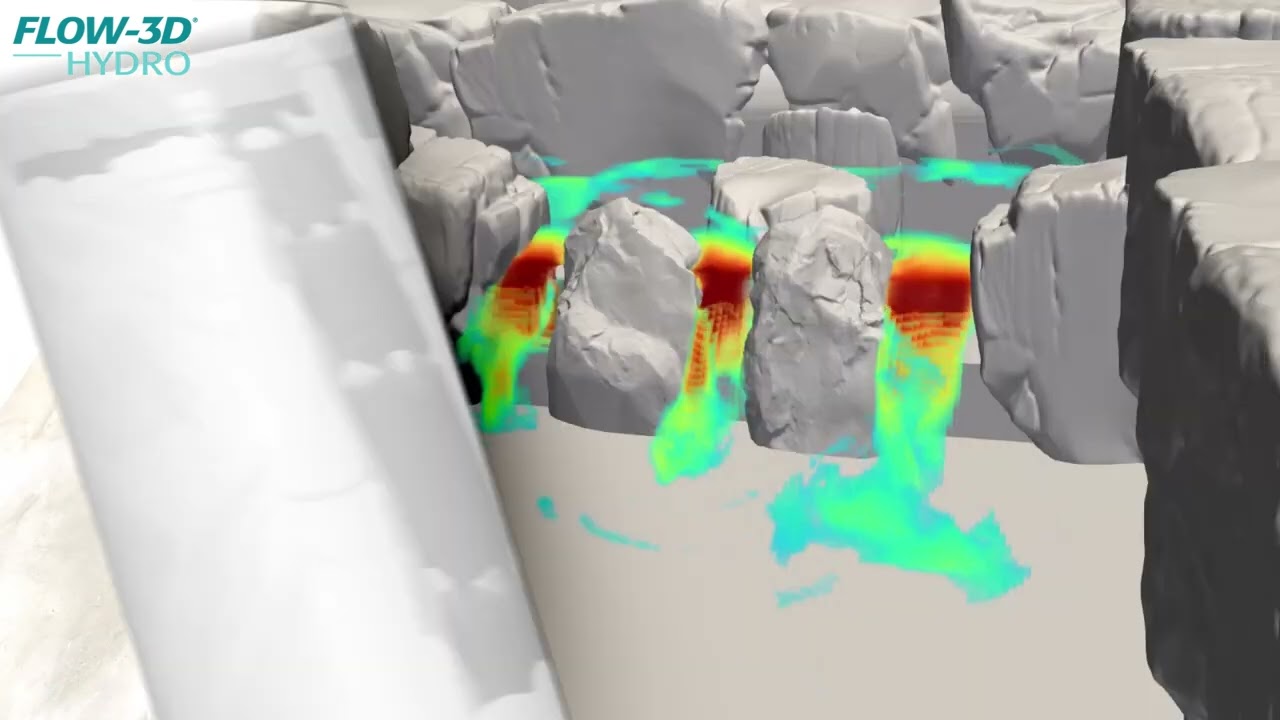
Constructed rock fishways are used to create a natural-looking fish passage to help fish navigate beyond in-stream structures like dams, weirs and culverts. Each fish species will have certain hydraulic characteristics that are optimal for attraction to and safe passage through the constructed fishway. FLOW-3D HYDRO is a fully 3D CFD simulation tool that allows for highly accurate and detailed prediction of the hydraulic conditions critical for successful fish passage design. 3D CFD simulations provide detailed insight into the hydraulics of your fishway design so that you can optimize the hydraulics of your structure to please your native fish species.
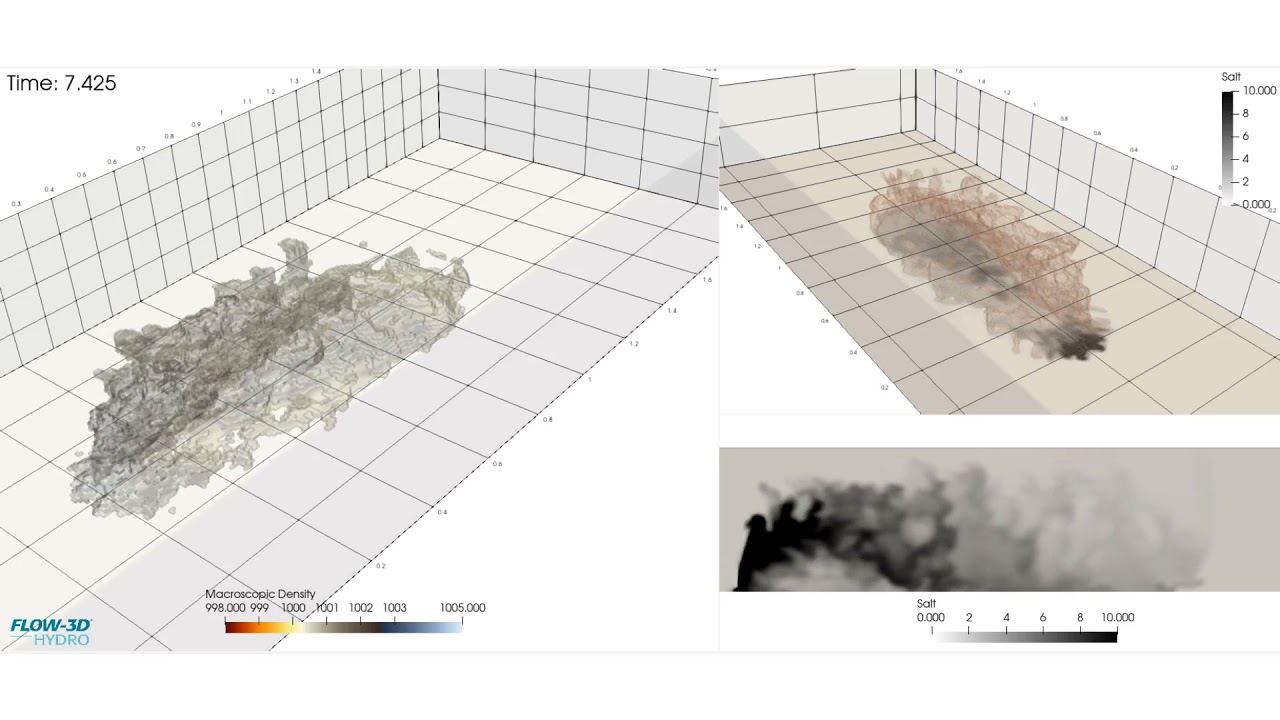
Here is a conceptual example illustrating a scalar transport simulation in FLOW-3D HYDRO. In this case, we are looking at the dispersion of a salt plume in freshwater. This is illustrated here with volume representations from FLOW-3D POST: macroscopic density (left) and salt concentration (right). The scalar physics model can be used to model a variety of applications: variable density plumes, thermal discharges, contaminant transport, mixing problems, etc.
This FLOW-3D HYDRO simulation uses the Hybrid 3D/Shallow Water model to better understand and more efficiently model bridge hydraulics. The simulation fully couples the 3D model with a 2D shallow water model together in one run. The surrounding areas to the bridge were modelled in full 3D, while the upstream and downstream areas of the river were modelled using a 2D shallow water model.
Bridges and culverts can undergo complex hydraulics when the water level overtops the roadway. In this FLOW-3D HYDRO example, the water level rises above the roadway and the bridge experiences pressure flow through the opening and weir flow over the bridge deck. A three-dimensional computational fluid dynamics model can help you quantify the complex hydraulic losses associated with bridges and culverts in overtopping situations.
This model of a floating flood barrier showcases FLOW-3D HYDRO‘s moving object physics. In this model, the floating barrier motion is coupled with the fluid flow. When the water level rises within the structure, the barrier floats upward to prevent the floodwater from passing beyond the barrier.
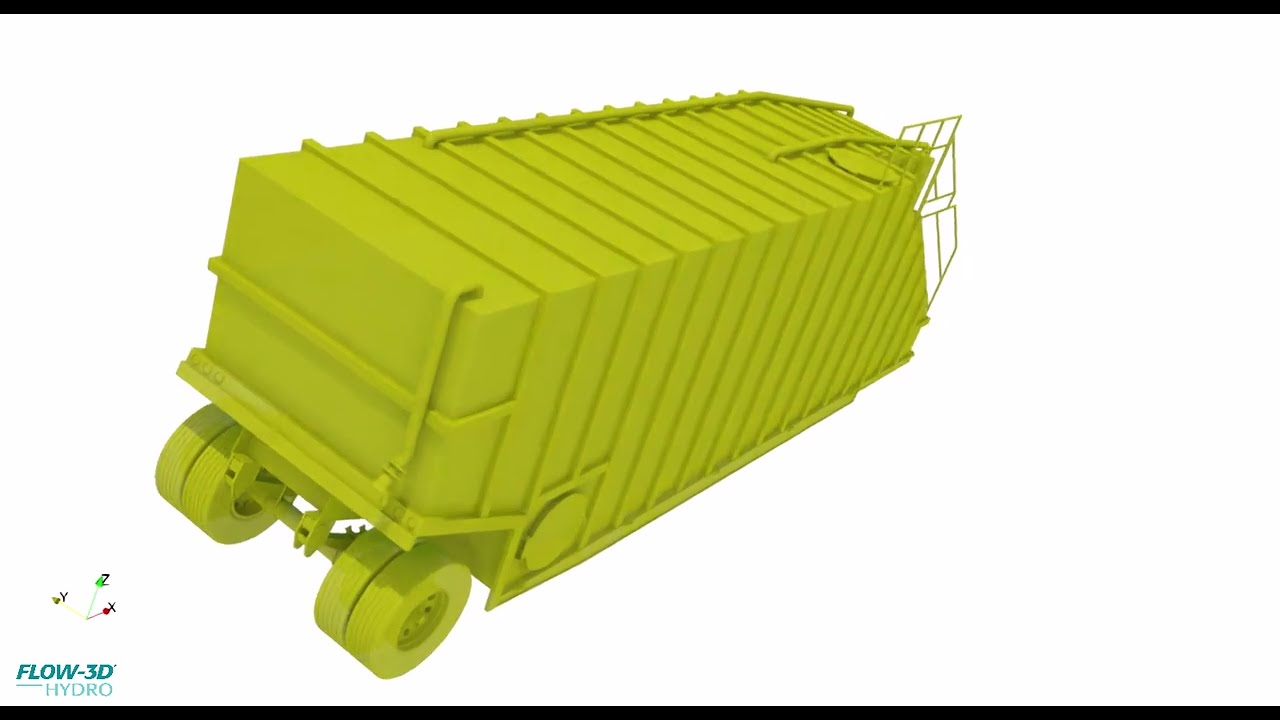
Hydraulic mixing is critical when using frac tanks in the oil and gas industry as a mobile water storage solution. Improved hydraulic mixing can lead to a more efficient treatment system. To model the hydraulic characteristics, the simulation was set up with a scalar model to visualize the mixing. The scalar model along with streamline plots and other advanced post-processing tools allows for easier analysis of an open-top tank with such a configuration.
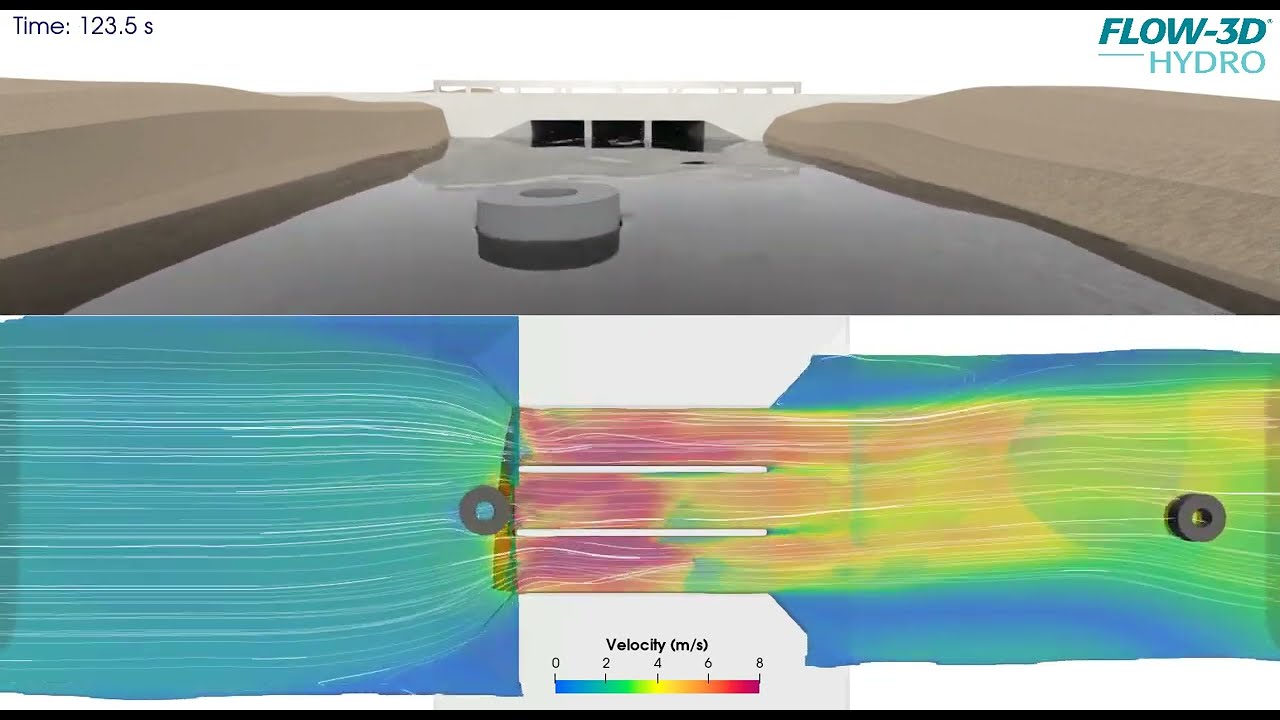
During significant flood events, debris can be transported down the waterway and become lodged at bridges and culverts. Accumulated debris can reduce the flow capacity of the bridge or culvert, this resulting in more flooding upstream. In this FLOW-3D HYDRO example, three tire-shaped objects and one tree trunk are released upstream of the culvert to see if they become lodged upstream of the culvert or are able to pass through. In FLOW-3D HYDRO, debris blockages can be modeled with dynamically moving objects or with stationary solid or porous objects placed in the model domain.
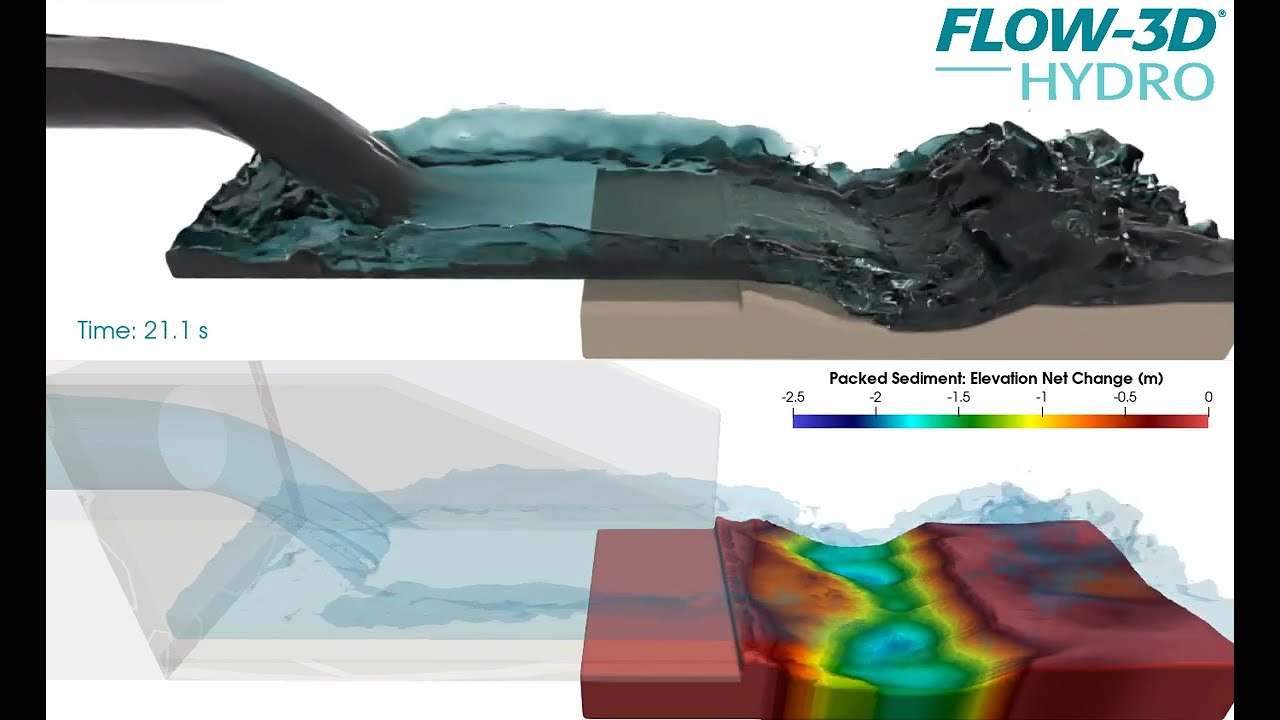
FLOW-3D HYDRO has sediment transport physics that let you assess sediment scour and deposition for a variety of applications. In this example, the area downstream of a culvert outlet consists of erodible material. During the simulation, a scour hole develops due to the high velocities exiting the culvert. The solid geometry and open volume dynamically adjust based on the amount of scour or deposition calculated during the previous time step.
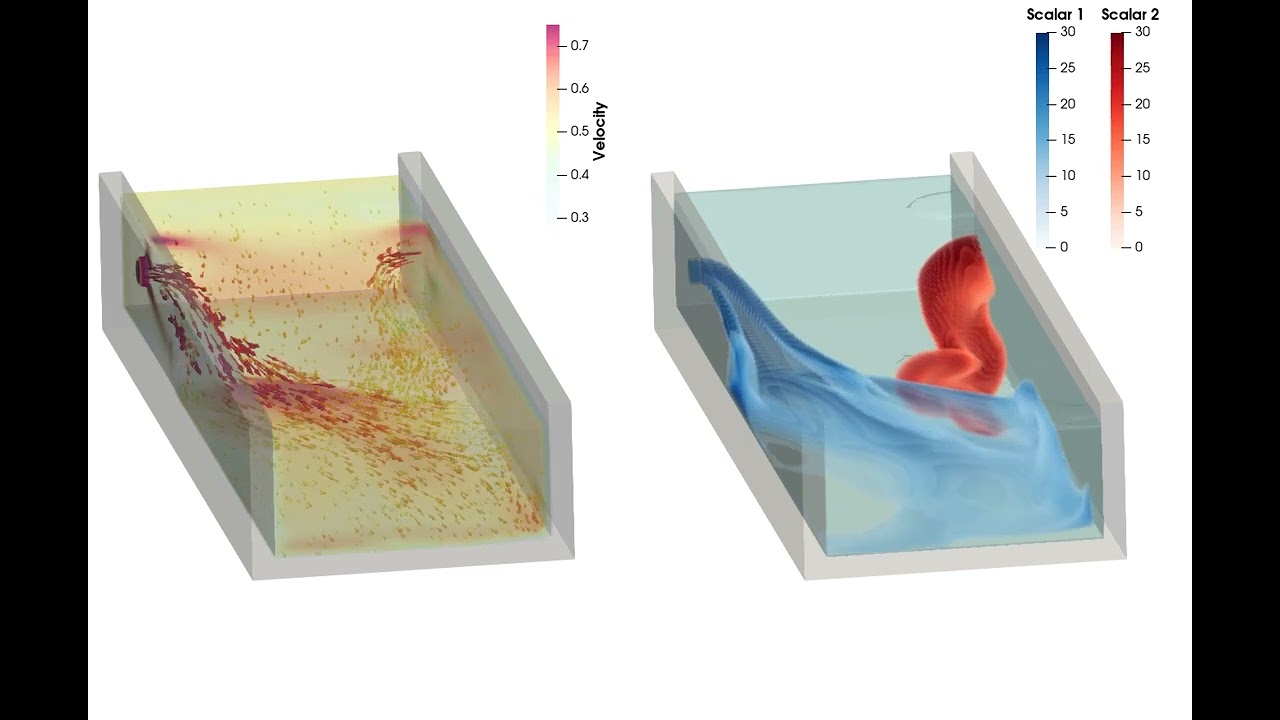
This model illustrates a simple scalar transport simulation and is included as one of the built-in examples in the FLOW-3D HYDRO user interface. Two side inlets add fluid with a defined scalar concentration to the main flow in a rectangular channel. For one inlet, the scalar concentration is defined as a passive property, while the scalar concentration is defined to modify the fluid density in the second inlet. This is one way FLOW-3D HYDRO can be used to model plume discharges for environmental impact assessments.
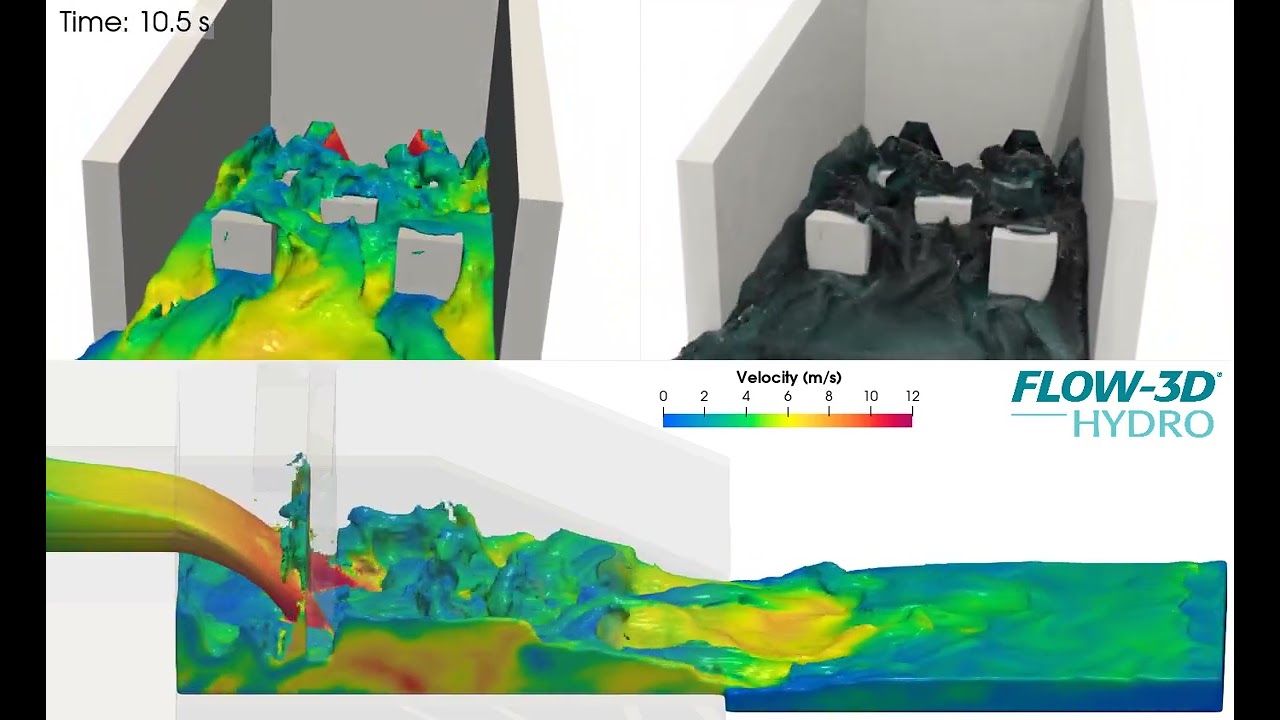
High velocities at culvert outlets can lead to problems with scour and erosion which can potentially undermine the culvert outlet or other nearby infrastructure. In FLOW-3D HYDRO, assessing different culvert outlet configurations is easy with FLOW-3D‘s meshing and geometry handling. In this example, a baffle block design is analyzed in an attempt to reduce the high velocities discharging from the culvert outlet.
Even shallow floodwaters can present hazardous conditions for vehicles trying to cross flooded roadways. In this FLOW-3D HYDRO example, the general moving objects (GMO) physics were used to simulate an initially stationary vehicle. The forces of the floodwaters are able to sweep the vehicle off the roadway and down the embankment. The GMO physics can simulate rigid body motion, which is either user-prescribed (prescribed motion) or dynamically coupled with fluid flow (coupled motion). This vehicle model is an example of the dynamically coupled option.
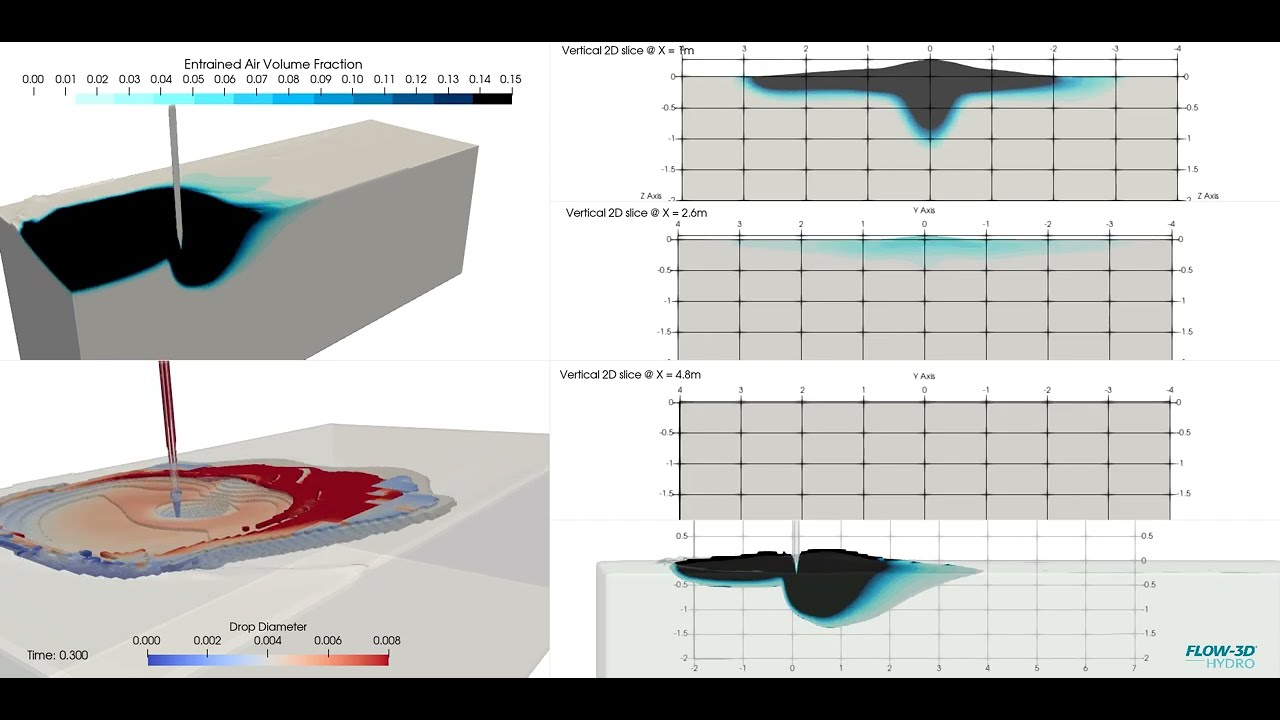
CFD simulation (1-fluid model) of air entrainment from a plunging jet of water into a flowing surface. The entrained air is modeled as a scalar that changes the fluid density (thereby bulking the mixture volume) based on the entrained air volume fraction. The model captures the entrained air bubble size (which affects drag and buoyancy) and accurately captures the advection, diffusion, and buoyancy effects as the entrained air moves downstream. Modeling air entrainment with a 1-fluid model reduces the computational complexity and overhead associated with using a 2-fluid model.
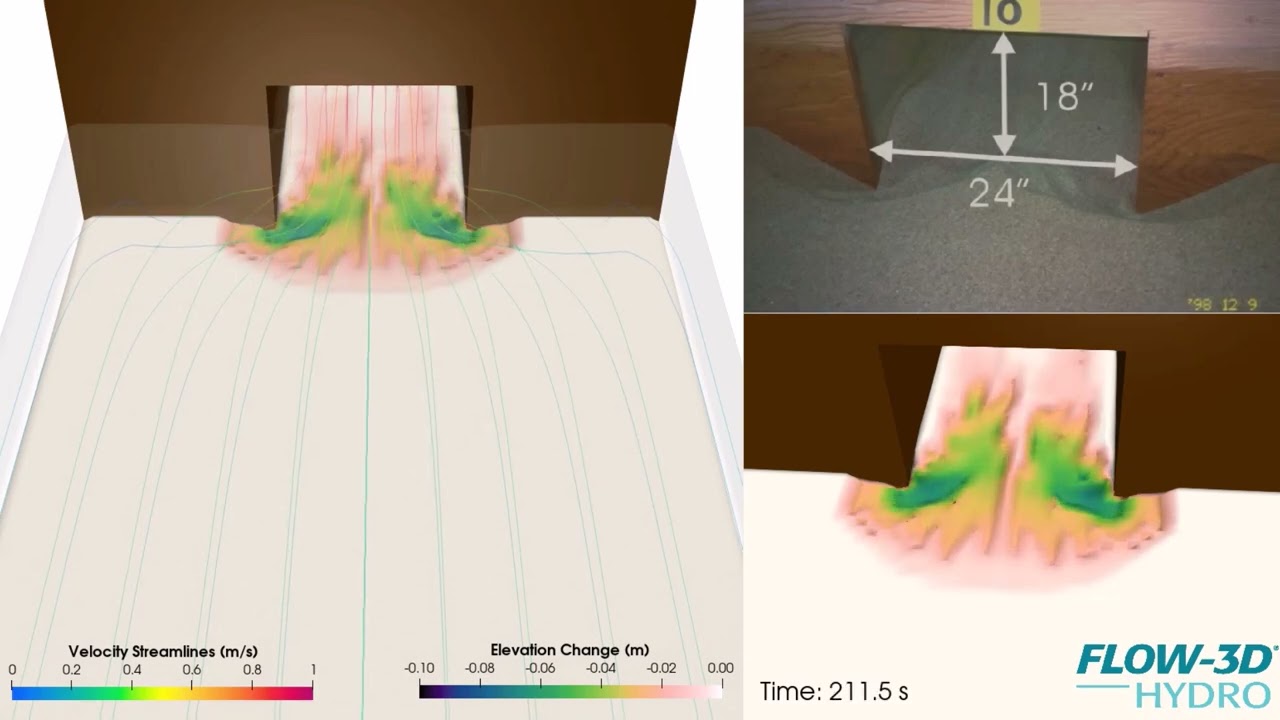
When a channel experiences a flow contraction at a culvert or bridge, the high velocities due to the flow contraction can lead to scour and erosion around the abutments. This FLOW-3D HYDRO example contains an approximate recreation of a similar laboratory test of flow contraction through a box culvert. FLOW-3D‘s sediment transport physics were used to model the scour around the entrance of the culvert.
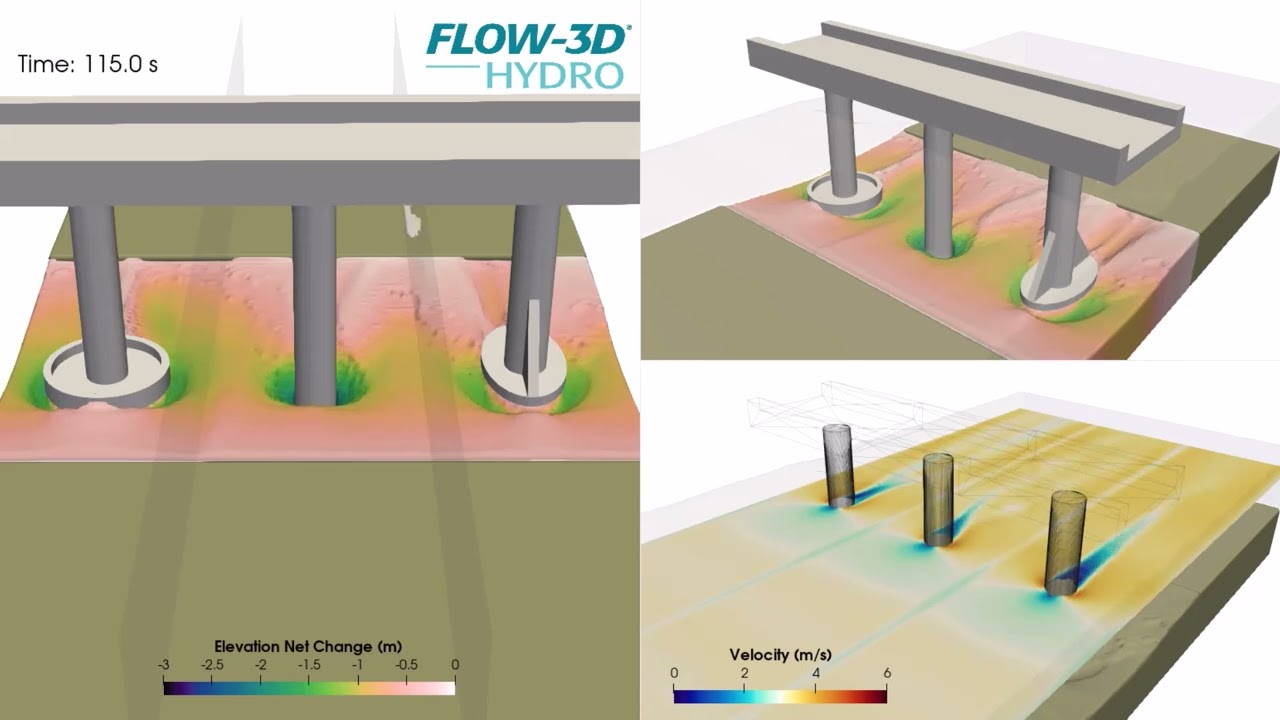
Scour of bridge substructure elements can lead to a failure or weakening of a bridge. Using FLOW-3D HYDRO‘s sediment transport physics, three bridge pier configurations are compared for a similar flow condition in this video. A collar design was included at the base of two of the piers to see what impact it has on the scour depth around the pier.
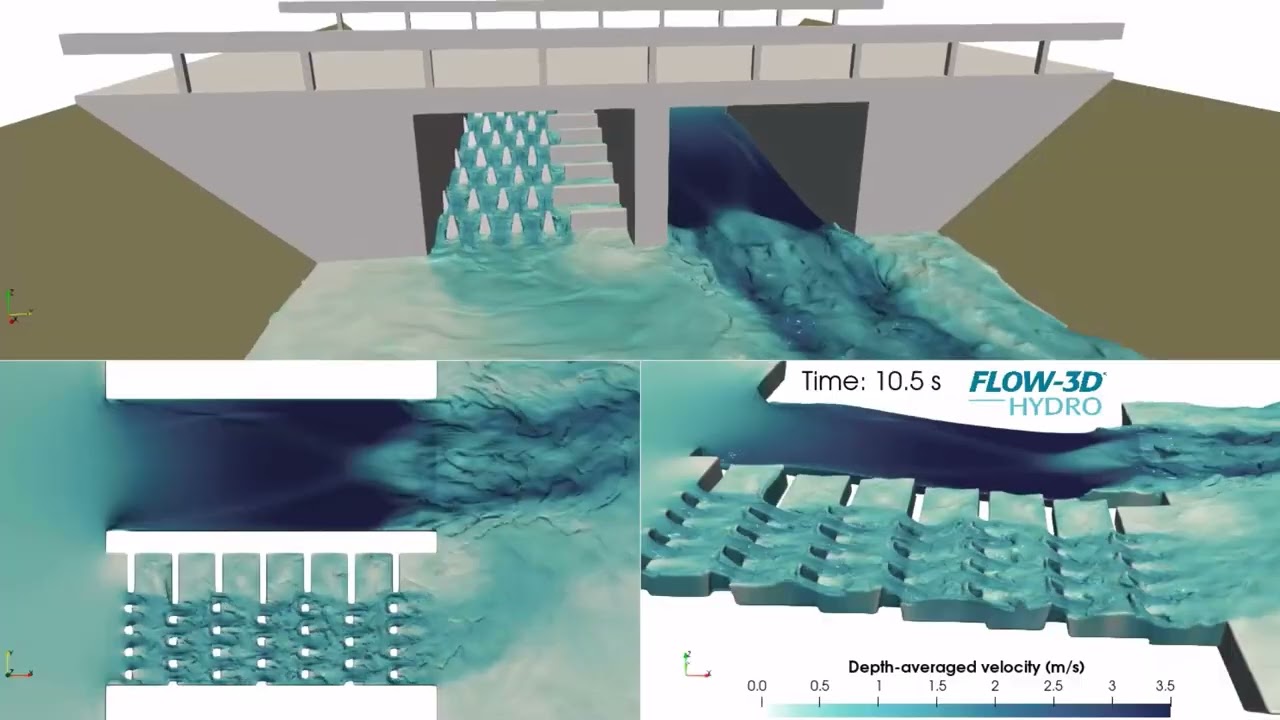
Culverts can interfere with natural stream flow and pose obstacles for fish passage, often due to high water velocities, shallow flow depths, or outlets elevated above the streambed. 3D CFD modeling enables engineers to design or retrofit culverts to be more fish-friendly. In this FLOW-3D HYDRO example, a dual-barrel culvert features a cone fishway on one side and a flat-bottom slope on the other. CFD allows for precise adjustments to the fishway design, offering detailed insights into hydraulic performance to ensure it meets the specific needs of local fish species.


