


Dams & Spillways Playlist

0:31

0:21

0:21
0:21
0:31

0:39
0:19

0:21
0:21
0:40
0:21
0:51

0:26
0:25
0:11
0:18
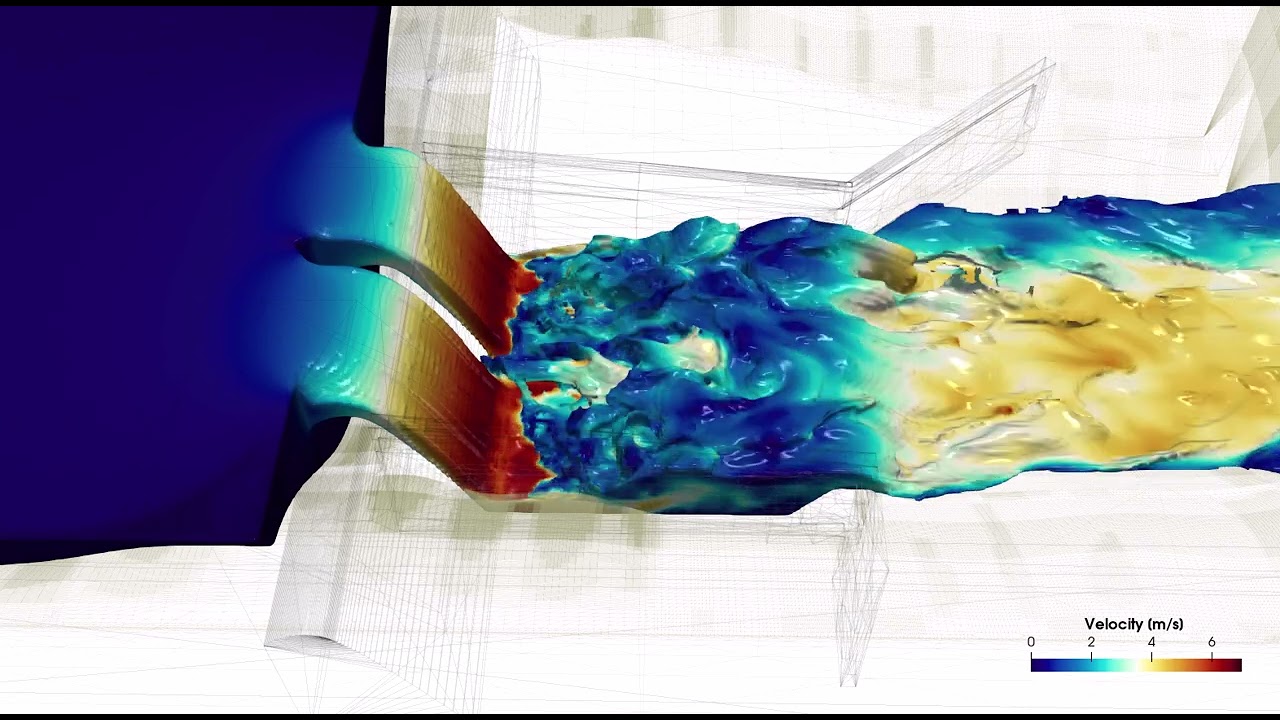
Advanced visualization capabilities allow engineers to communicate complex hydraulic analysis results effectively by integrating multiple data sources into compelling presentations. This FLOW-3D HYDRO visualization demonstrates post-processing workflows in FLOW-3D POST, combining CFD simulation results with 3D scan data of the terrain and CAD geometry of the spillway structure. The rendering showcases ray tracing capabilities for realistic visualization followed by velocity field analysis. FLOW-3D POST enables engineers to create high-quality visualizations that integrate simulation results with real-world site data for stakeholder presentations and technical analysis.
This is a FLOW-3D HYDRO simulation of the Isabella Lake Dam, which features a labyrinth weir. It was created using 3D geometry made publicly available by the USACE Sacramento District. This was done to demonstrate the FLOW-3D POST rendering capabilities, first showing a combination of satellite map texture on the terrain data with velocity field, then using ray tracing for realistic rendering.
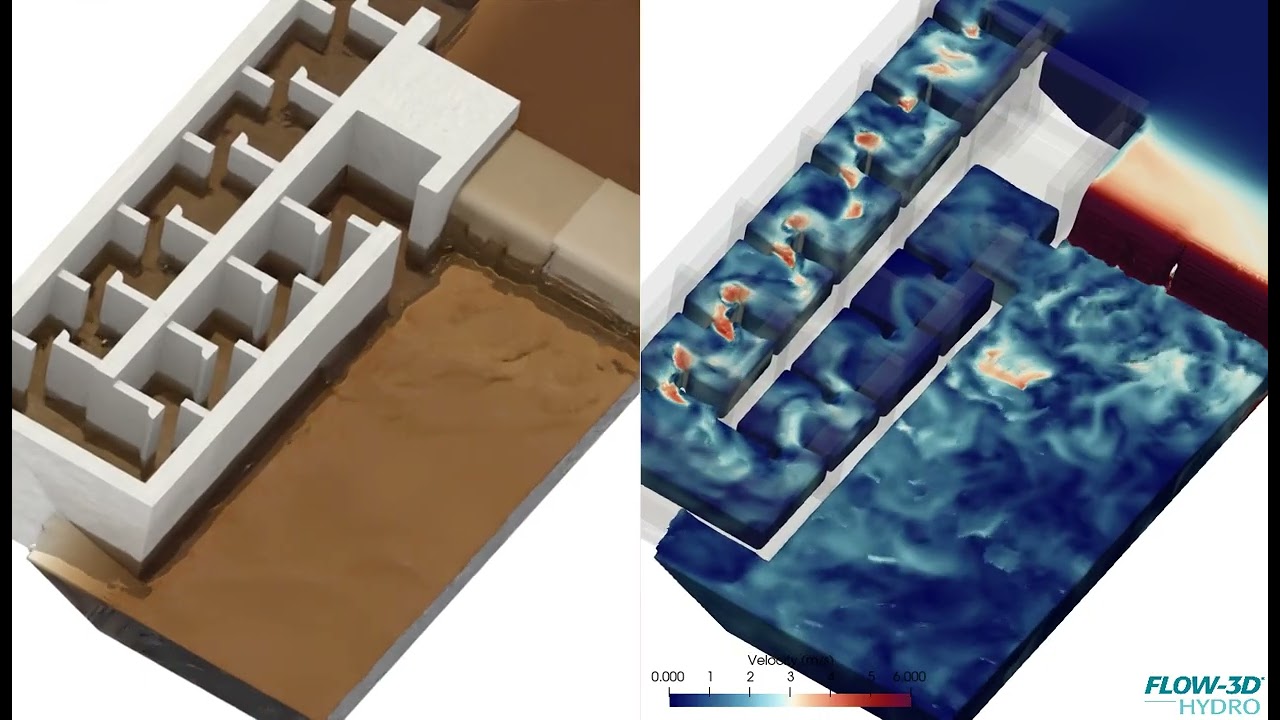
Piano key weirs (PKW) are complex non-linear spillway structures that increase discharge capacity within constrained footprints, making accurate hydraulic analysis essential for design optimization. This FLOW-3D HYDRO simulation demonstrates flow through a PKW geometry, showcasing both realistic rendering capabilities and technical visualization options. The video presents realistic ray-traced rendering alongside 2D section cuts colored by velocity magnitude with vector displays, illustrating how engineers can extract useful technical information from simulation results. CFD modeling helps dam professionals analyze complex spillway geometries and optimize PKW designs for both existing and proposed projects.
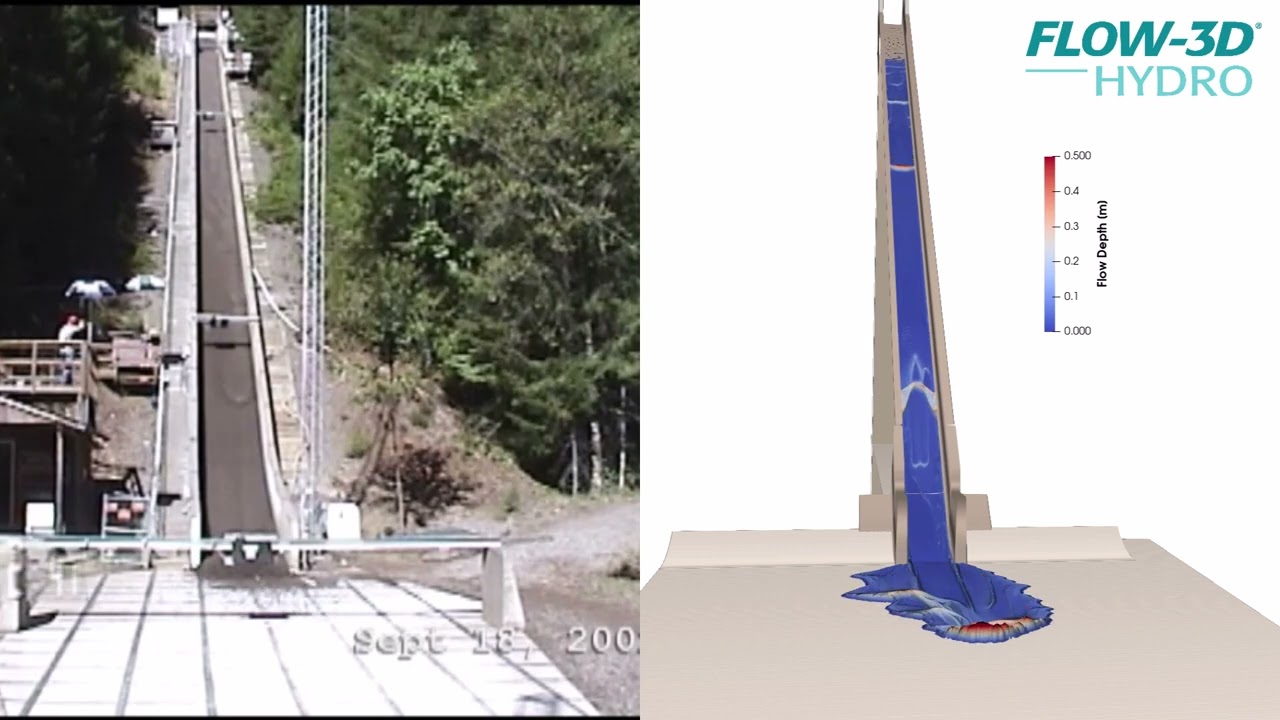
FLOW-3D HYDRO’s ease-of-use and volume of fluid method make it an ideal choice for modeling three-dimensional (3D) free surface flows often seen in civil and environmental engineering applications. It is often used for spillway applications where you need to establish a rating curve (spillway flow vs. upstream water level) or need to design the energy dissipation structure. In this spillway example, the initial dissipator design showed that flow could overtop the sidewalls and potentially cause erosion. The sidewall height was increased to contain the flow within the dissipator structure.
Fish passage structures at weirs must accommodate the swimming capabilities and hydraulic preferences of target fish species to ensure successful upstream migration. This simulation demonstrates a vertical slot fishway design at a weir, identifying key velocity zones that determine passage suitability for different species. The software captures complex flow patterns, turbulence characteristics, and velocity distributions that affect fish passage success. CFD modeling helps engineers optimize fishway geometry to meet hydraulic requirements for all target species while maintaining passage efficiency.
FLOW-3D HYDRO provides you with the option of modelling tailings dam breaks with a two-dimensional (2D) computational mesh, a three-dimensional (3D) computational mesh, or a hybrid combination of 2D and 3D meshes. In this example, a purely 2D mesh is used to model the same tailings discharge hydrograph into two different ambient conditions. In the top video, a tailings discharge occurs into a dry creek bed. In the bottom video, the same tailings discharge occurs with the creek initially flowing with water.
FLOW-3D HYDRO was used to evaluate tailings flow sensitivity to various modeling options and rheological parameter inputs. Flow behavior was modeled using a full-scale numerical flume composed of an 80 m long, 2 m wide rectangular channel with a 10 cubic meter discharge of saturated tailings. Results from this study provide a guide to understanding model sensitivity to input parameter uncertainty.
FLOW-3D HYDRO can help you assess whether your fish passage will be suitable for all of your targeted fish species by identifying key velocity zones, as shown in the lower left corner of the video where the high velocity regions are highlighted. It can also help you inspect flow patterns throughout the structure, as illustrated by the velocity streamlines on the right side of the video.
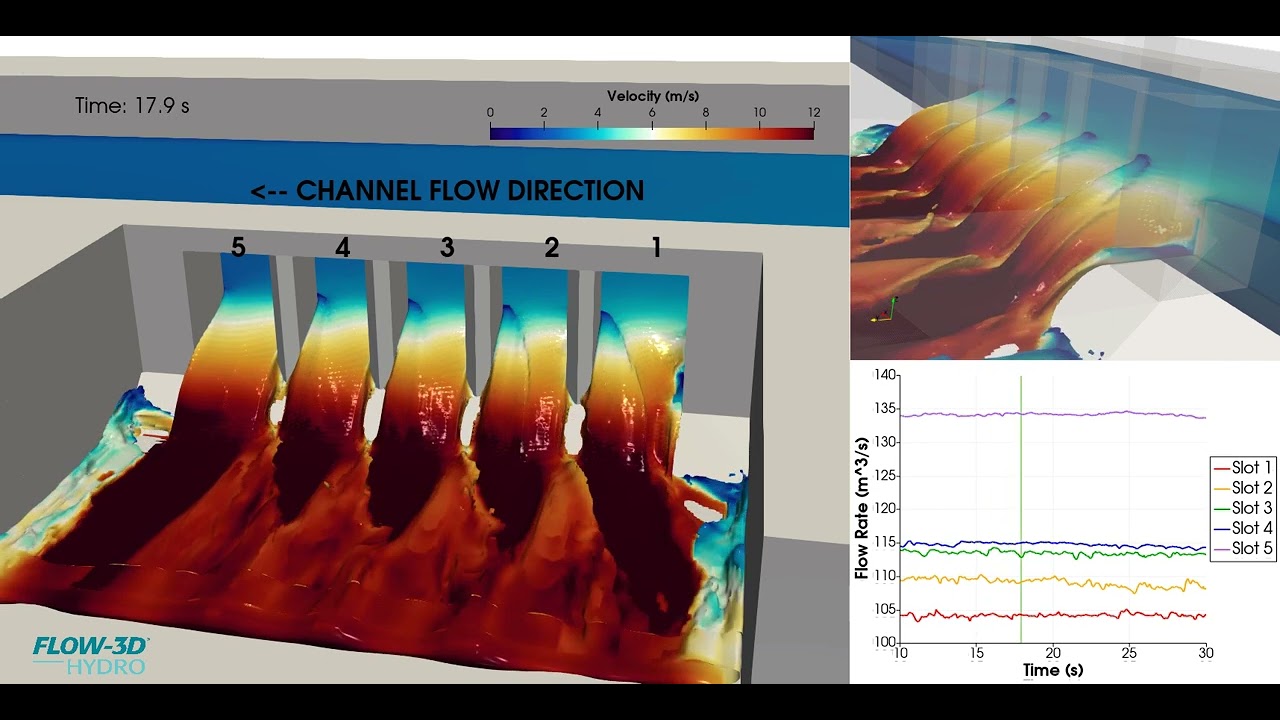
Estimating the flow through a side spill weir can be a challenge and dependent on the site-specific geometry and hydraulics of the main channel. This FLOW-3D HYDRO example illustrates how you can quantify the flow through each opening of a side spill weir for a given weir geometry and flow condition.
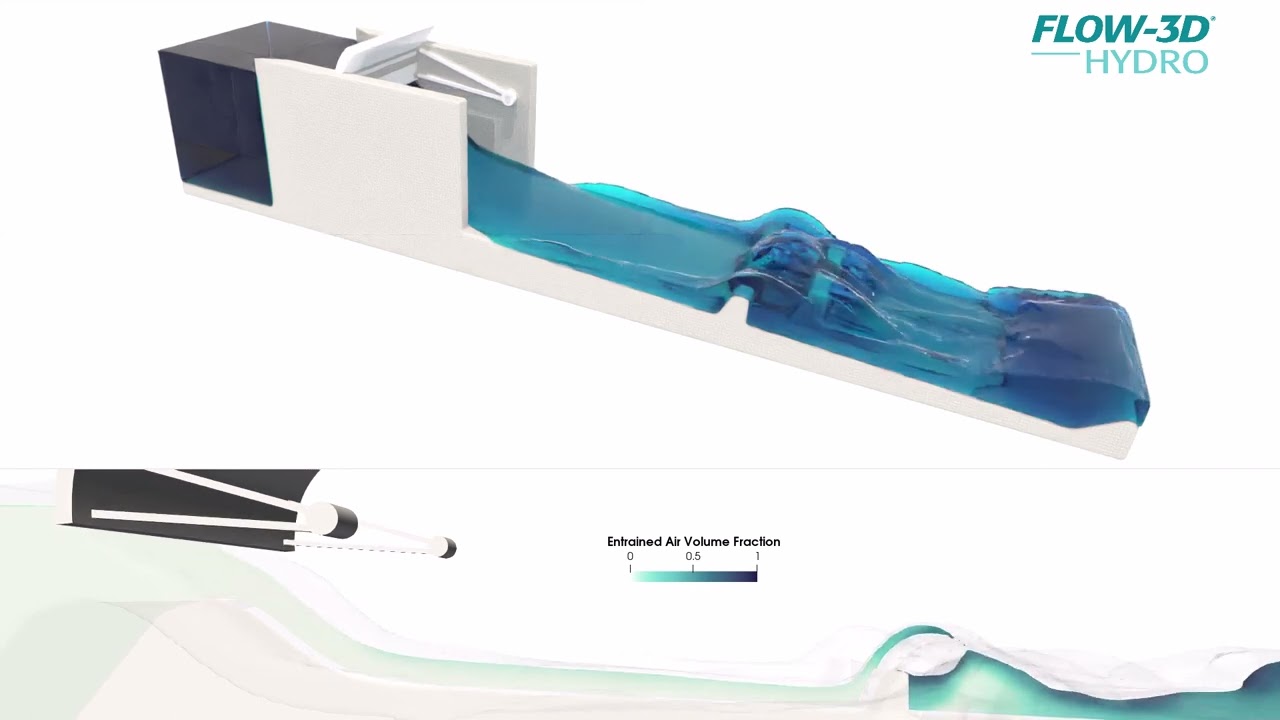
In this FLOW-3D HYDRO simulation, the flow starts as the tainter gate starts to open. As the flow continues down the spillway and over the energy dissipators, air is entrained by the added turbulence and the complex flows as the fluid impacts the dissipators. FLOW-3D HYDRO tracks both the entrainment of the air and the transport of the entrained air.
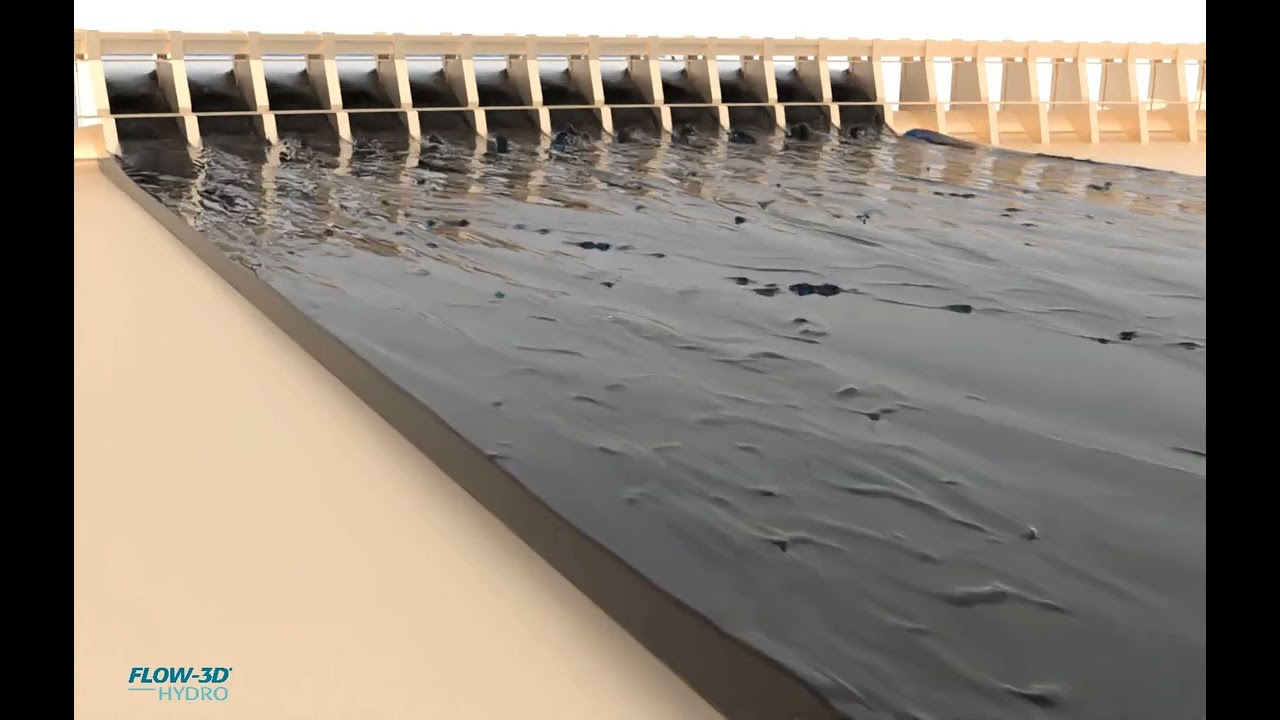
High-quality visualization of CFD results can effectively communicate complex hydraulic phenomena to stakeholders and decision-makers. This realistic rendering of the Garrison Dam Spillway was created using FLOW-3D POST‘s ray tracing capabilities, based on validated FLOW-3D HYDRO simulation results. The underlying numerical model was validated against physical model data from the US Army Corps of Engineers Omaha District, demonstrating strong agreement in discharge, water surface elevation, and pressure. Advanced rendering tools combined with validated CFD models provide powerful communication and analysis capabilities for hydraulic structure design.
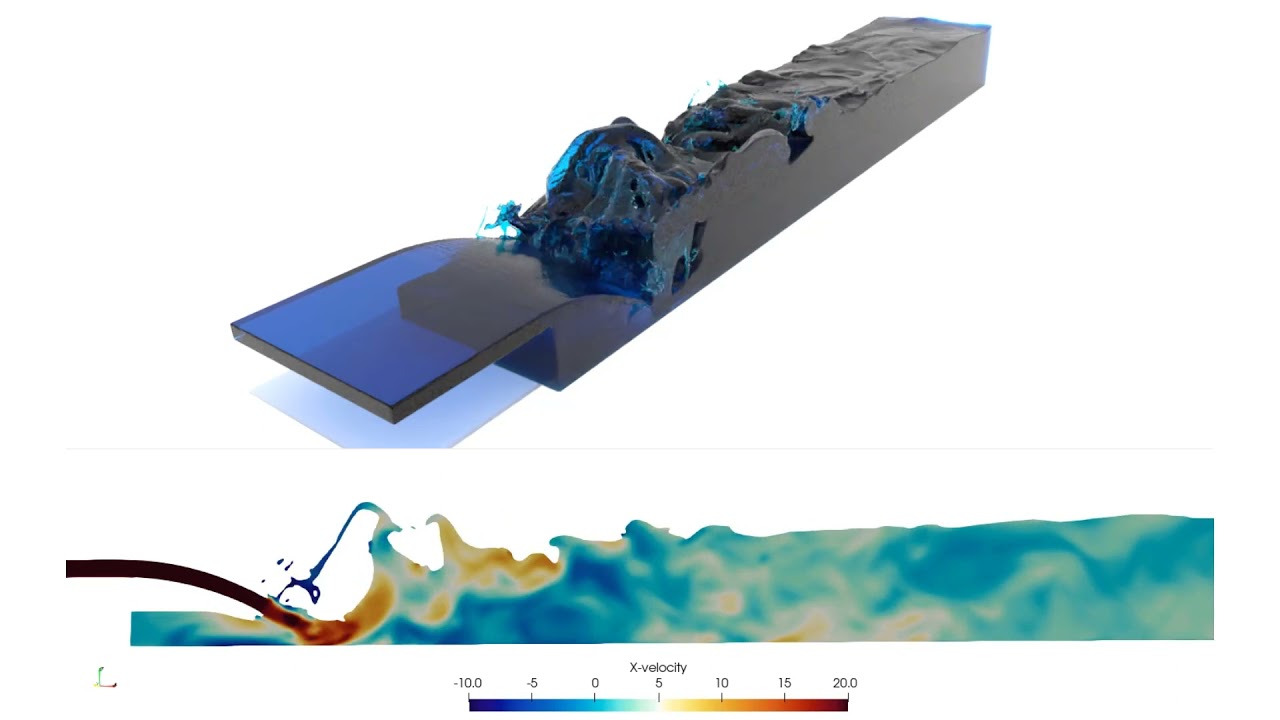
Here is a FLOW-3D HYDRO simulation of the development of a hydraulic jump. The top view is a ray-traced rendering of the flow; the bottom view, a 2D slice of the velocity field. This simulation was postprocessed with FLOW-3D POST, our advanced postprocessor for visualization and analysis across FLOW-3D products.
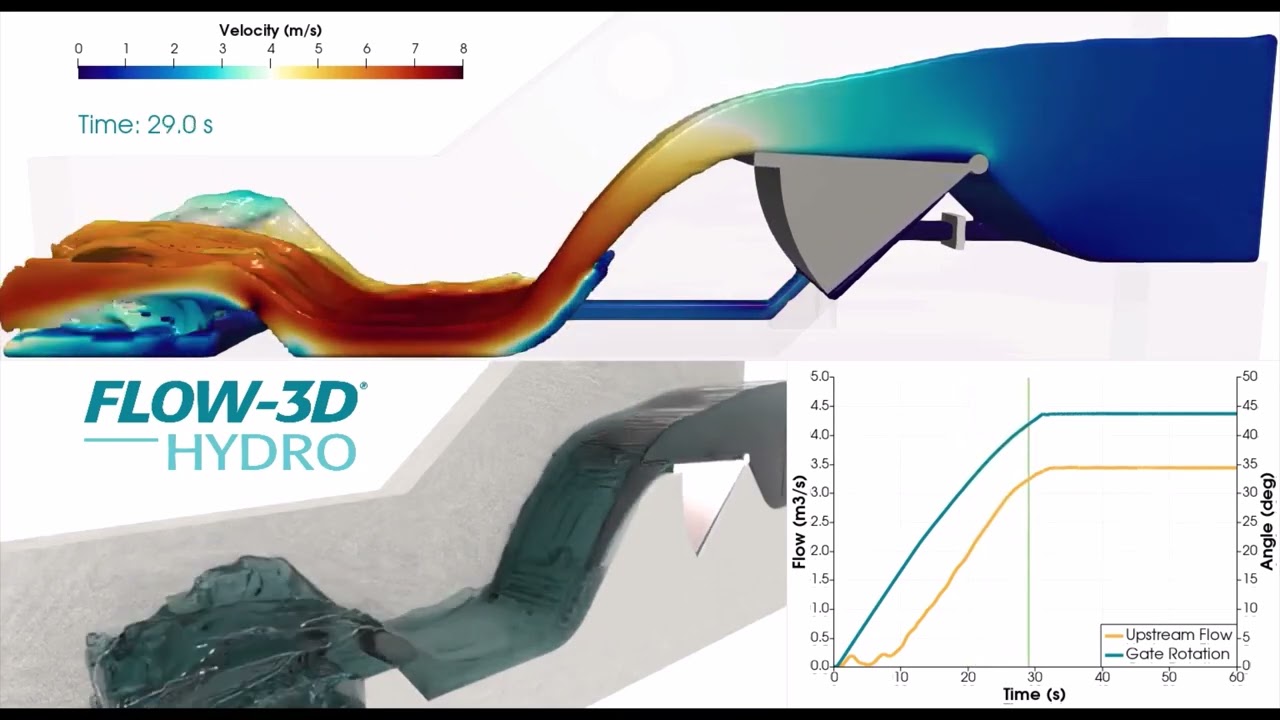
In this FLOW-3D HYDRO spillway example, the moving object physics incorporates a prescribed motion to simulate the sequential opening of tainter gates. While this example models a dynamic gate opening scenario, a similar steady-state model could be used to develop a rating curve of spillway capacities at various combinations of upstream water levels and fixed gate positions to assist with dam operating scenarios.
Drum gates are controlled through the operation of a hydraulic chamber beneath them. In this FLOW-3D HYDRO example, the chamber’s downstream gate is opened which allows the hydraulic chamber to drain and lower the floating gate. FLOW-3D HYDRO‘s moving object physics are used to allow the drum gate to rotate about a fixed axis depending on its interaction with the fluid around it.
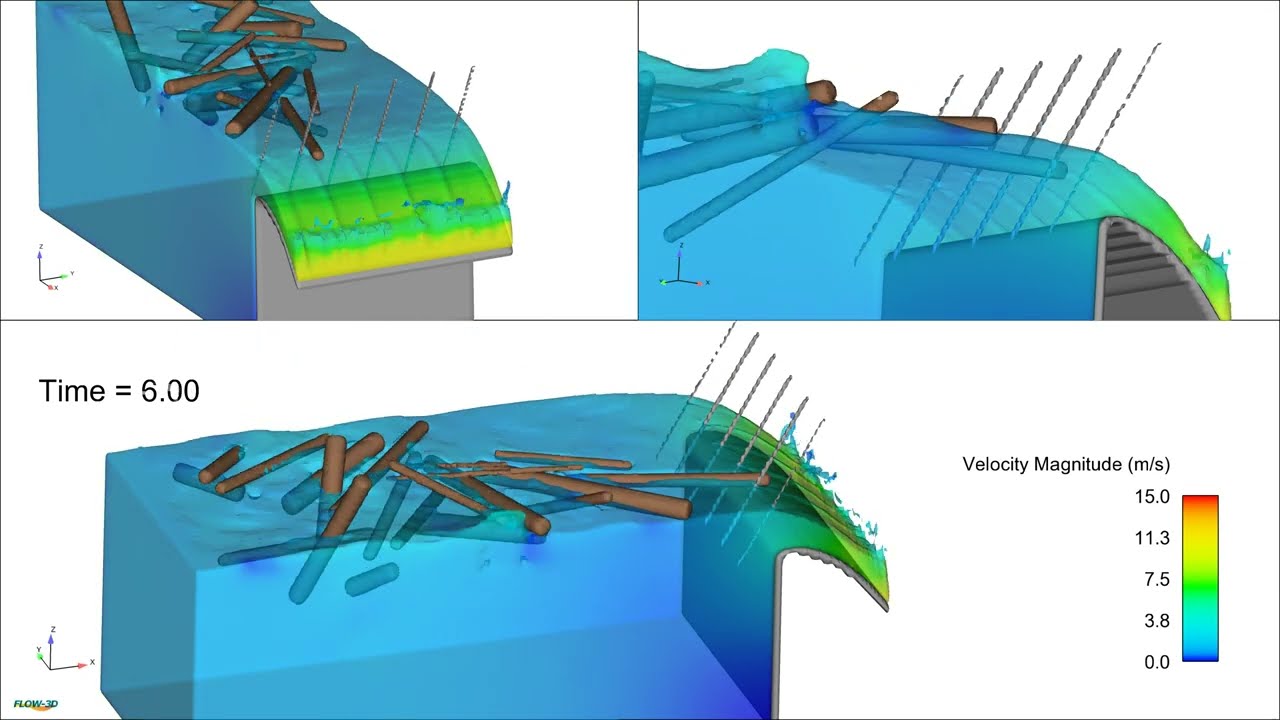
This spillway model highlights FLOW-3D HYDRO‘s moving object capabilities. The logs are free to move and collide with each other and the debris screen at the spillway crest. Each object’s motion and fluid flow are coupled dynamically and affect each other. You can model hundreds of independent moving objects within a single FLOW-3D HYDRO model.
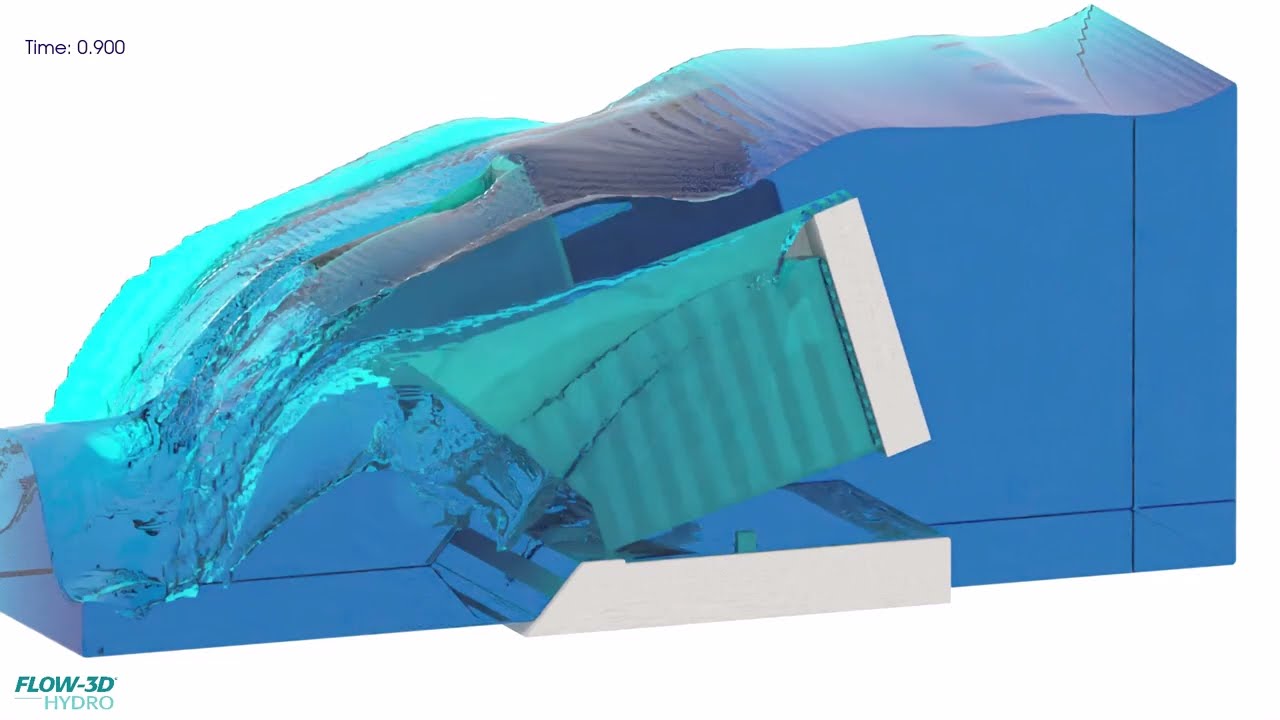
Fusegates have been added to reservoirs as a way to increase water storage capacity of the reservoir. Under normal operation, flood conditions will flow over the fusegate crest similar to a typical weir. For larger flood events, water can flow into the fusegate inlet well and lead to an uplift pressure that causes the fusegate to tip. This FLOW-3D HYDRO example models the tipping condition of a fusegate under an extreme flood condition. The general moving object physics has been used to simulate the motion of the fusegate.


