


Squeeze Pins Model
As castings grow more complex and wall sections thicker, shrinkage porosity in hard-to-feed areas can become unavoidable even with optimized gating, risering, and die temperature management. In high pressure and permanent mold casting, squeeze pins are a proven tool for addressing this problem: hydraulically actuated pins that press into the solidifying metal to compensate for shrinkage volume and reduce or eliminate porosity in targeted locations.
The Squeeze Pins Model in FLOW-3D CAST simulates the behavior of squeeze pins during solidification, allowing engineers to evaluate pin placement, sizing, timing, and activation strategy before committing to tooling. The effectiveness of squeeze pins is highly dependent on getting these parameters right, and simulation is the most practical way to explore the design space.
How the Model Works
The Squeeze Pins Model in FLOW-3D CAST is based on the prescribed-motion General Moving Objects model and works in conjunction with the Simple Shrinkage Model. Once activated, a squeeze pin senses the amount of shrinkage in the adjacent liquid metal and moves in to exactly compensate for that volume. The pin advances along a defined line of action until it either reaches its maximum travel distance or encounters sufficient solidified metal on its working surface to prevent further movement.
A force can be specified for each pin, which is translated into metal pressure. This pressure can be coupled with the Thermal Stress Evolution Model and Porosity Formation Model to predict the effect of intensification pressure on residual stress and porosity distribution in the solidified casting.
The shot sleeve plunger can also be defined as a squeeze pin during solidification, allowing the model to capture the effect of intensification pressure applied through the plunger after cavity fill is complete.
Activation Control
Squeeze pin timing is critical. A pin activated too early may push metal out of the cavity through an unsealed gate. A pin activated too late may encounter too much solidified metal to move effectively. The Squeeze Pins Model offers three activation modes to support both the design stage and production validation:
- User-prescribed time: the pin activates at a specified time, suitable when timing has been determined from prior simulations or process experience
- Automatic activation: the pin activates when the adjacent liquid metal is sufficiently isolated from free surfaces, preventing metal from being pushed out of the cavity. The automatic mode also checks that the pin is not connected to another pin through a contiguous liquid path, avoiding competition between pins. This mode is most useful during the design stage when exact timing is not yet known
- Active Simulation Control: the pin activation is controlled by simulation state variables at specified locations in the casting, allowing the user to replicate the logic of the actual squeeze pin control system on the die casting machine
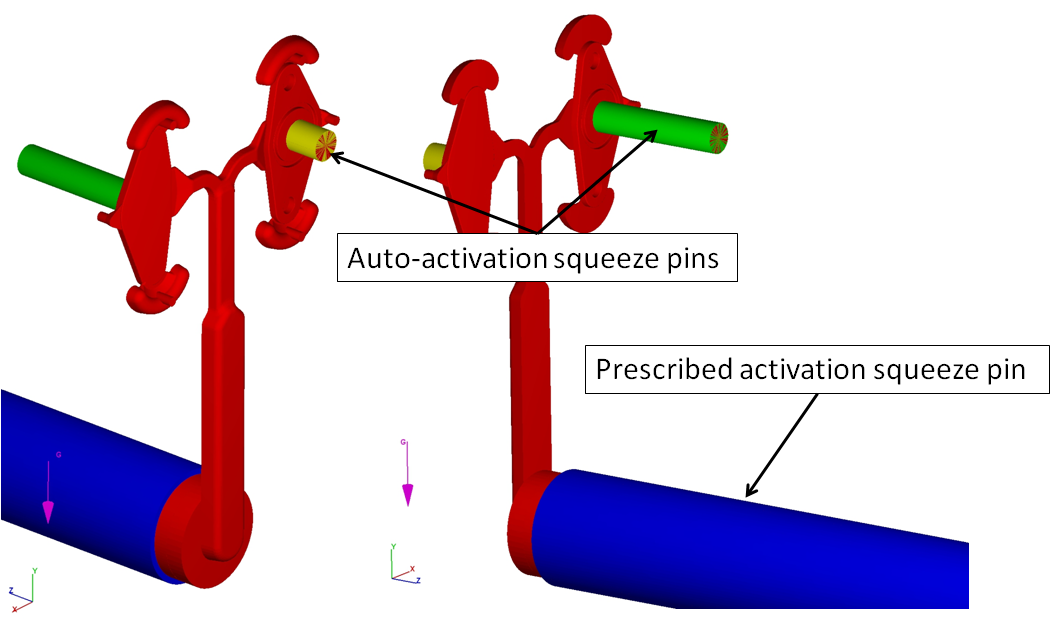
Case Study: Two-Cavity HPDC
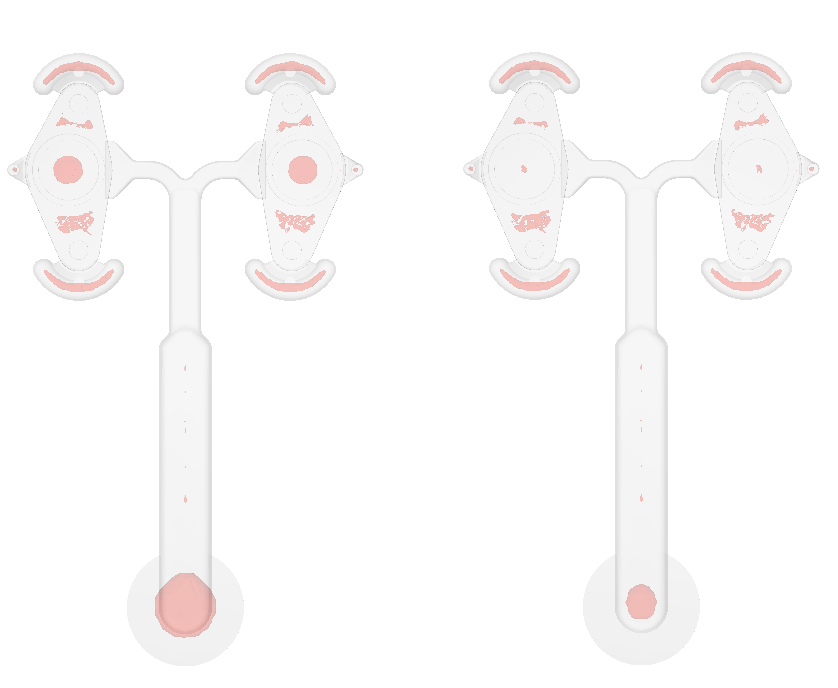
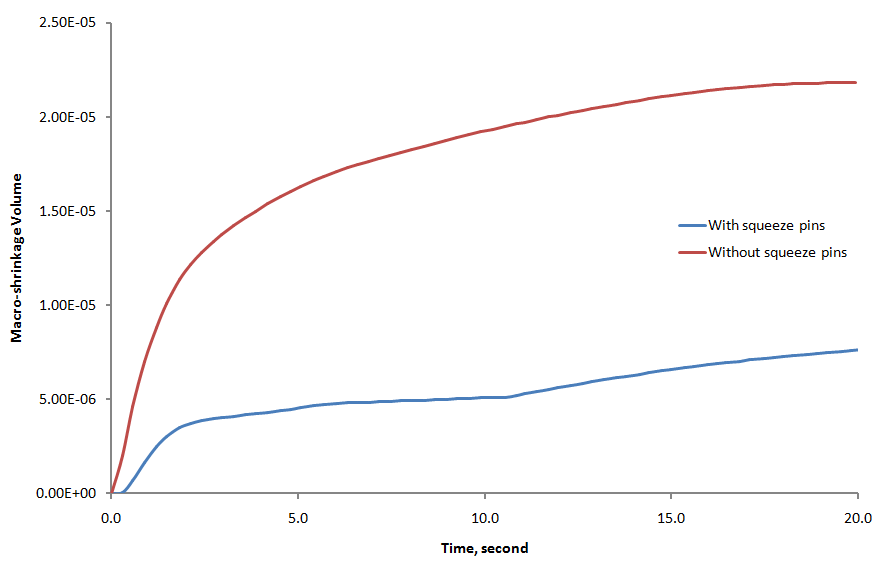
A case study was carried out on a two-cavity high pressure die casting (HPDC) to demonstrate the effectiveness of the Squeeze Pins Model. Two sets of simulations were run: one without squeeze pins and one with squeeze pins configured at the locations identified as most prone to shrinkage porosity. The simulations without squeeze pins predicted significant porosity in the thick sections of the casting. With squeeze pins activated at the optimal time, the model predicted a substantial reduction in porosity at those locations, consistent with what is observed in physical production with squeeze pins engaged.
Applications
The Squeeze Pins Model in FLOW-3D CAST is used to:
- Determine optimal squeeze pin placement to target shrinkage porosity in thick or isolated casting sections
- Evaluate pin timing to maximize effectiveness without risk of pushing metal through unsealed gates
- Size squeeze pin force and travel to achieve target metal pressure at the defect location
- Assess the effect of intensification pressure on porosity and residual stress using coupled models
- Replicate the squeeze pin control logic from the die casting machine to validate the production process
- Compare design alternatives for pin layout on complex multi-cavity dies