

Hybrid Shallow Water/3D Flow Model
Many hydraulic engineering modeling problems required fully three dimensional simulations and span multiple length scales. A dam impounding a large reservoir, a bridge pier in a river, or a structure in an open coastal area all involve three-dimensional flow features embedded within a much larger domain. Flow in the larger domain may provide critical boundary condition information but may not always need to be simulated in three dimensions. In those cases, the computational expense of a large 3D model can be reduced with a Hybrid 2D/3D model
The Hybrid Shallow Water/3D Flow Model in FLOW-3D HYDRO was developed specifically to improve modeling efficiency for this class of problems. In a single time step it combines the computational efficiency of shallow water (depth-averaged) equations with the local accuracy of full 3D Navier-Stokes equations where vertical flow structure matters. For example, engineers can model catchment-scale flood routing and a complex hydraulic structure in the same run.
The shallow water model can also be used alone (without a coupling with a 3D local model). This can be useful for preliminary screening of very large domains requiring a large number of scenarios, or for the generation of a hot start for a 3D model.
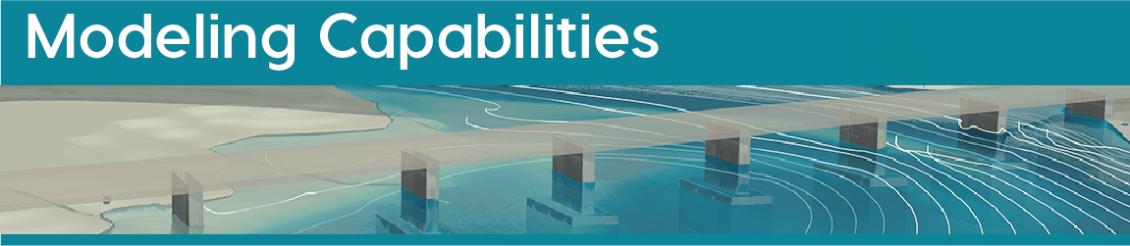
Hybrid 3D/shallow water simulation of bridge hydraulics. The surrounding river reach is modeled with a 2D shallow water block; a nested 3D block resolves the velocity structure and flow details around the bridge piers. Color denotes velocity magnitude.
How the Model Works
The model uses FLOW-3D HYDRO‘s multi-block meshing framework. Each mesh block is independently designated as a shallow water or 3D block. In shallow water blocks, the depth-averaged shallow water equations are solved for water surface elevation and depth-averaged velocities. In 3D blocks, the full unsteady Reynolds-averaged Navier-Stokes equations are solved, resolving the three velocity components, pressure and turbulence structures.
At the boundaries between adjacent or nested blocks, the solutions are coupled: the shallow water block provides boundary conditions for the 3D block, and the 3D block returns updated flow information to the shallow water block.
Blocks can be arranged in two configurations. Adjacent blocks share a face along their common boundary, suitable for transitioning from a shallow water domain to a 3D domain around a structure. Nested blocks place a 3D block entirely inside a shallow water block, drawing boundary conditions from the surrounding flow and feeding back into it.
In shallow water blocks, bed friction can be calculated using the Manning, Chezy, Strickler, Nikuradse , Colebrook-White, Haaland, Ramette and Soulsby log law formulations. Bed friction can be applied as a uniform value or mapped spatially from an external file, allowing realistic representation of floodplains with mixed land cover. Horizontal turbulent mixing in shallow water blocks is governed by a constant diffusivity, mixing length, or Smagorinsky sub-grid scale model. The Shallow Water Model does not need to be run in combination with a 3D mesh block.
Simulation Examples
Thermal plume during a flood event

A thermal power plant discharges warm cooling water into a river. Locally, the outfall creates a concentrated buoyant plume that gradually mixes vertically and laterally. Because the river is shallow compared to its width, vertical mixing is quickly achieved while lateral mixing occurs over a larger domain. The nearfield discharge is modeled in 3D to capture the vertical breakup of the plume. Far field lateral mixing can be modeled with the shallow water model. The hybrid modeling approach allows better definition of the environmental impacts of the thermal plume and the benefits of better diffuser design.
Wave propagation over a complex topography

Applications
Potential applications for the Hybrid Shallow Water/3D Flow Model in FLOW-3D HYDRO are diverse:
- Large-scale flood routing with detailed modeling of control structures, bridges, culverts, outfalls
- Bridge pier and abutment hydraulics in winding rivers channels
- Coastal and offshore structure design in open water environments
- Spillway hydraulics where flow patterns in the reservoir can significantly affect the spillway performance.
- Urban drainage and stormwater infrastructure analysis where shallow water flooding interacts with hydraulic structures such as culverts.
- Fish passage and environmental flow assessment
- Tsunami and storm surge propagation with localized structure interaction that requires a 3D model.